
Town of Black Mountain facing significant budget shortfall in general and water funds
Financial planning workshop presents ‘painful’ path to upcoming fiscal year
Fred McCormick
The Valley Echo
May 21, 2026
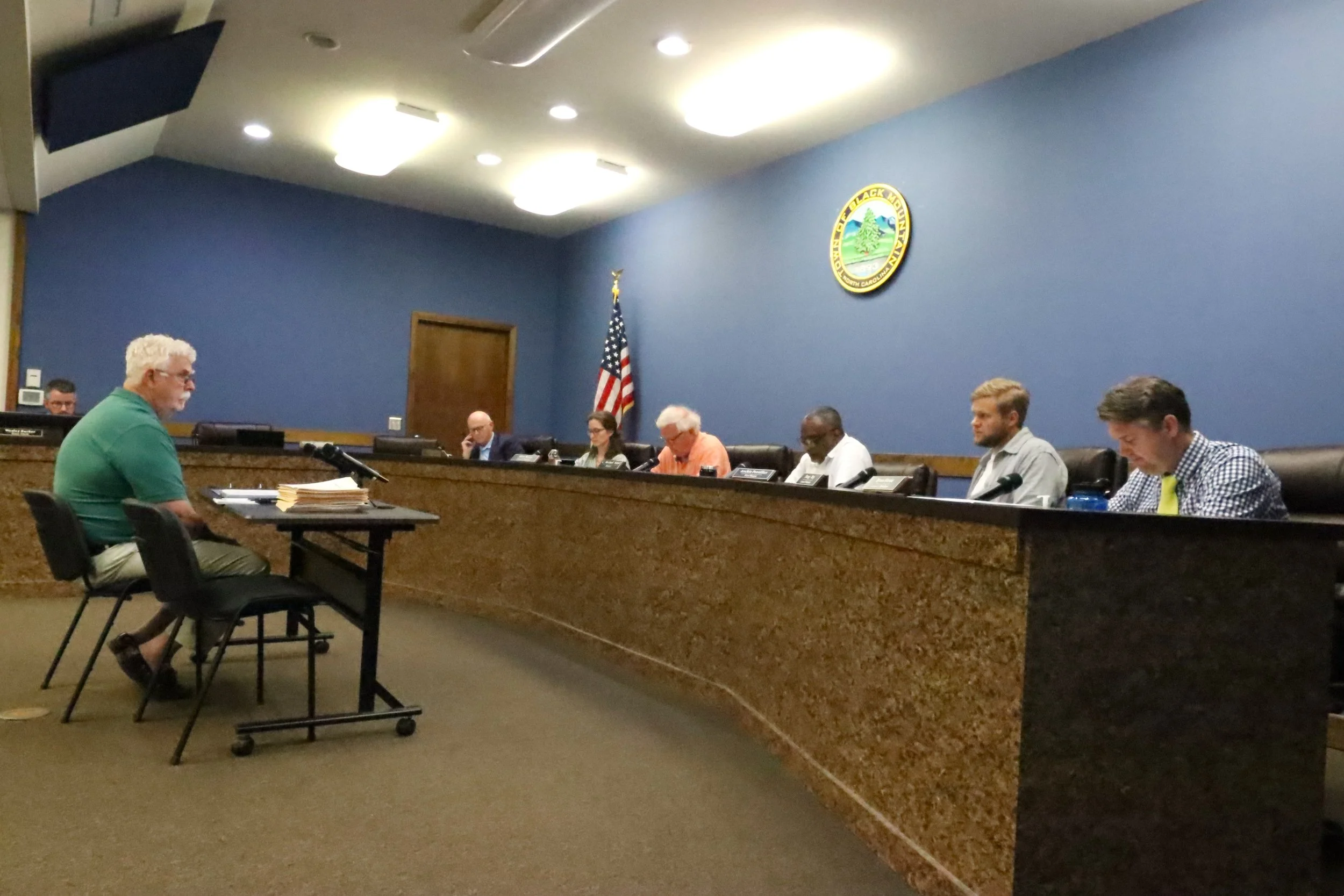
The Black Mountain Town Council reviews a draft of the 2026-27 budget, May 20, with interim manager Richard Hicks. Photo by Fred McCormick
An approximately $1.9 million shortfall in the general fund and additional $918,000 deficit in the water fund will present challenges in a complicated financial planning season, the Black Mountain Town Council learned, May 20 and 21, in a pair of work sessions held over three hours.
As elected leaders reviewed the first draft of the 2026-27 budget, balancing expenditures and revenues will likely require a series of difficult decisions, prior to the upcoming fiscal year, which begins, Wednesday, July 1.
Presented by interim town manager Richard Hicks, the 135-page document included a detailed budget message, outlining the complexities of the planning process, which will continue with a series of workshops.
“Balancing the budget will require some difficult decisions and prioritization of the level of services that the Town will be able to provide,” the opening paragraph of his statement concludes. “This budget is also more complex due to a proposed bill within the N.C. General Assembly that could potentially delay the implementation of the property revaluations.”
Under its current budget, Black Mountain generated $5.7 million in tax revenue from real property and vehicles, at its adopted rate of 32.1 cents per $100 of valuation. A revenue neutral ad valorem tax rate of .229, under reassessed values released last February by Buncombe County, would generate $6 million in revenue for the town, while the current rate under previous values would generate $5.9 million.
“Originally, we based our numbers on this being a revaluation year, but since we started this budget there has been a bill, which has passed in the senate and is currently in the house, that would delay that for a year,” Hicks said. “Whether or not it gets vetoed by the governor would be another question, but with so much bipartisan support, I don’t think they’d have much trouble getting it overturned.”
Based on the current shortfall, a property tax rate increase of 6.8 cents per $100 of valuation, over the revenue neutral rate of .229, would be necessary, without additional cuts, to balance the budget. A freeze of revaluations would require a hike of 9.75 cents over the current rate. An increase of 3 cents on a $500,000 home would cost taxpayers an additional $12.50 per month, according to the report.
“Normally, I would give you a recommended tax rate and have this finalized, but we are currently facing a significant shortfall, and I’m not from here and don’t know what’s important to council. I’ve already cut some, and I could make deeper cuts, but I don’t know what your goals and ambitions are,” Hicks told the council. “I don’t know how much pain you’re willing to endure, because there is definitely going to be some pain.”
Sales tax revenue, which represents the town’s second major funding source, is lower than expected in the current year, the administrator added.
“It’s about a 2.4% increase, and in prior years we were seeing 7, 8 or 9% increases in sales tax,” he said. “We’re seeing it statewide, where it’s just about flat. In years past you had some growth there, but this is not much growth.”
Projected revenue from the funding, which is collected by the state and distributed monthly to the municipality, is less in the upcoming fiscal year than in the current budget, according to Hicks.
Solid waste fees of $8 per household would generate approximately $425,000 in 2026-27, funding approximately 37% of the $1.1 million operating costs of the town’s sanitation department.
“As you get into your budget discussion, I think that’s something you should look at, if you want to recover more of those costs,” Hicks said.
Another major budgetary change noted by the interim manager is the lack of availability of money in the unassigned fund balance.
“There is a good chance that, by June 30, your fund balance is going to be around 12%,” Hicks said. The state requires municipalities to maintain at least 8% of the general fund expenses in its unassigned holdings, while the town’s policy is 30%. “In the current budget year you budgeted $561,000 from your balance, and I don’t think you can do that anymore.”
He advised the town council to establish methods to rebuild the fund in the coming years.
“The state requires one month of operating expenses, but the (Local Government Commission) says you need four to five months,” Hicks said. “You’re a long way from that, so I think you need to be looking at ways to build that back up.”
The top expenditure for the town was identified as employee salaries, which, with benefits, account for 51% of the total budget, according to Hicks.
“We currently don’t have any salary increases in the budget, so when I say you’re $1.9 million short, if you want to do a salary increase, you have to add that on to that number,” he said, estimating the cost of a 1 % raise at approximately $100,000. “I can tell you, if you don’t do one, your salaries will not be competitive.”
The town’s water fund, which will be impacted by an anticipated 32% increase in wholesale rates from the City of Asheville, would require a $25 per month increase for customers using 5,000 gallons per month to overcome its deficit of $918,479,479.
“In your current budget year, you budgeted revenues at $2,475,350, and you’re going to fall about $375,000 of that projection,” Hicks told the council. “Also, in your current (water) budget, you used $265,527 from your fund balance, which you don’t have anymore.”
Expenditures in the water fund, he added, are expected to exceed revenues by approximately $500,000 this year.
“You lost about $400,000 the prior year, so if you lose $500,000 this year, that’s a pretty big hit in two years,” he said.
With costs rising, the budget presentation did not bring “much positive news” for the town, Hicks said, before adding that one potential funding source was gaining momentum.
“We are starting to get money back from FEMA, and I know you advanced around $1.5 million from the fund balance, so as that money comes in, you can put it back or use it a your match to begin on projects,” he said.
Mayor Michael Sobol asked the administrator if he planned to recommend cutting any staff positions in the upcoming fiscal year.
“With staff being 51% of your budget, if you’re going to make significant cuts that’s where your money is,” Hicks responded.
Local officials will continue the budgeting process at 8:30 a.m., Thursday, May 28, when the town council gathers for a special called work session.