
Black Mountain bear encounter illustrates growing conflict and concerns
Human habits creating calorie-rich environment, influencing animal Reproduction and behavior
Fred McCormick
The Valley Echo
May 20, 2026
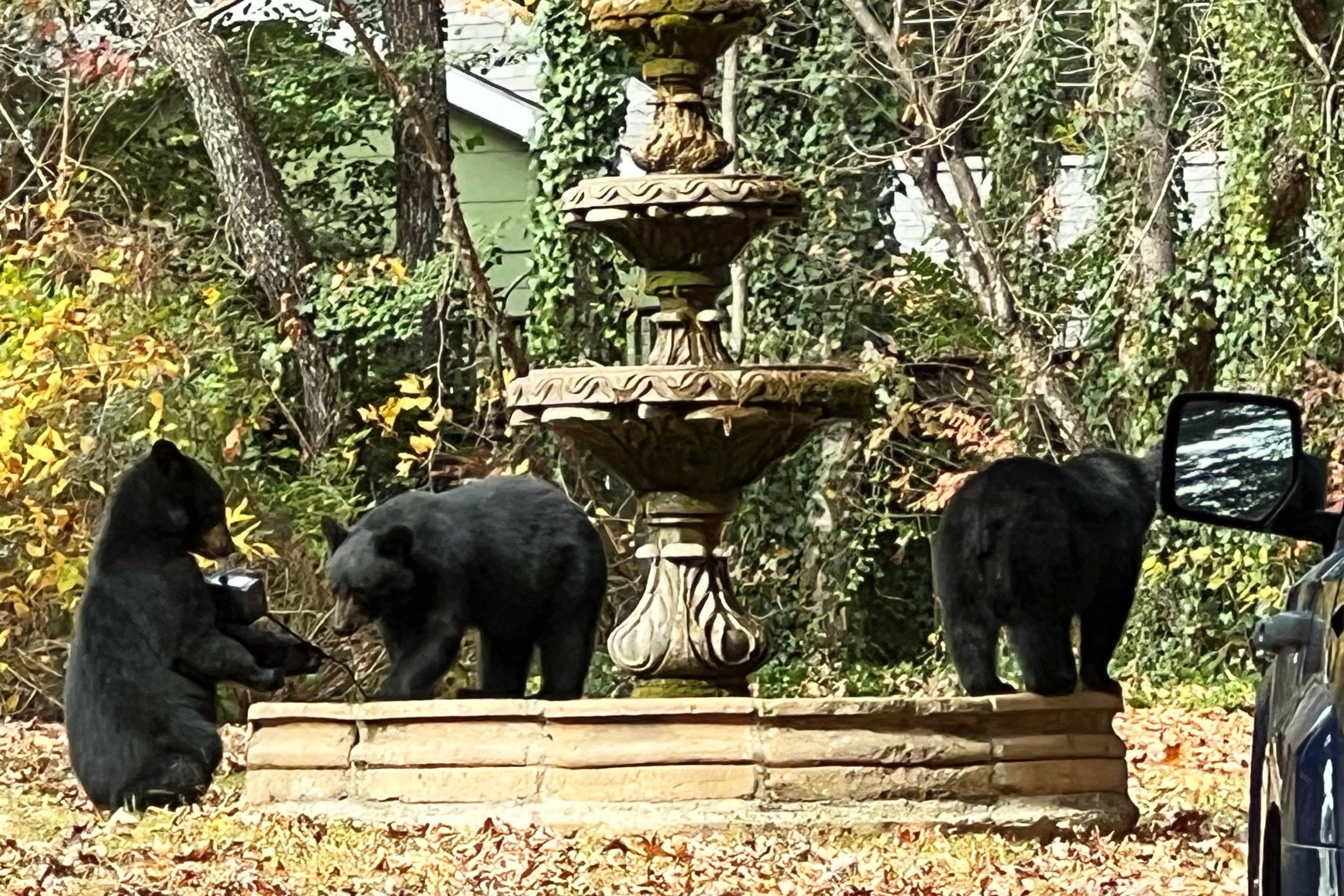
A family of black bears walks through a Black Mountain neighborhood. Photo by Fred McCormick
Bear sightings are not uncommon around the neighborhood Lisa Milton and her family have called home for more than 20 years, but when they returned to their house on the edge of the Black Mountain town limits, the last day of April, there was more than enough cause for concern.
As she publicly recounted her adult daughter’s frightening encounter with one of the animals inside the home, the local resident asked Black Mountain officials to address growing concerns about human behavior and its impact on bear safety in the community.
Milton, in a May 11 public comment to the Black Mountain Town Council, told local leaders that a bear opened the front door to gain entry into the residence when her daughter was upstairs. While the animals have long been active in the neighborhood bordering the YMCA Blue Ridge Assembly, the behavior it exhibited was far from normal, she said in a May 19 interview.
“As long as we’ve lived in that house, we’ve never even had a bear on our front porch, let alone open the door and come in,” Milton said. “We don’t feed the birds and we always make sure to secure our trash, so we’ve been doing everything to possible to keep something like this from happening.”
Hearing the door open, the occupant of the home began walking downstairs to investigate, but found her only egress blocked by the animal.
“Fortunately, she knows what to do when she encounters a bear, so she started making noise and yelling, but it was between her and the door,” Milton said. “She was lucky the door remained open after it came inside, because eventually it ran out.”
When the resident descended the staircase in an attempt to close and lock the front door, the bear charged.
“That bear tried to get back through that door four times,” Milton said. “Finally, she got more leverage and pushed the door closed and locked the deadbolt. Her strength was the only thing that saved her, but I don’t know if I would have been able to do that in that situation.”
The encounter, which ultimately led to the capture and removal of the sow, was “severe,” according to N.C. Wildlife Resource Commission BearWise Coordinator Ashley Hobbs, who noted incidents in the neighborhood around Blue Ridge Assembly Drive have increased in recent years.
“We had reports of a female with yearlings, nearby, coming into homes, opening cabinets and searching for food,” Hobbs said. “Obviously, entering homes crosses a line into human safety, so those bears were targeted for removal.”
The NCWRC will not trap or relocate nuisance black bears, but behavior that escalates to “bold and threatening” requires the animal to be euthanized. The process, which typically utilizes culvert traps to capture the bear, is “heartbreaking,” according to Hobbs, and proved harrowing for the the Milton family.
“After they identified this bear, they set up a trap, and we could hear it once it was in there,” Milton said. “Hearing that from our house was an awful experience. We just kept reminding each other that this wasn’t our fault, or the bear’s fault. That was a big part of what really led me to go speak to the town council.”
Interactions between bears and humans are increasing throughout Buncombe County, according to Hobbs, identifying “human behavior” as a single term representative of multiple factors. The Asheville Urban/Suburban Black Bear Study conducted by N.C. State University and the NCWRC, found the species was thriving in the area.
“What that study has shown us is that, as humans, we provide so many extra calories on the landscape, whether it’s through trash, bird feeders, pet food, things like that, we are kind of artificially inflating local bear reproduction,” she said. “Our bears have three to four cubs per litter, instead of two to three, as they should. The survivorship of these litters is really high, as well. These cubs go on to have their first litter of cubs earlier than their rural counterparts.”
Through consumption of human food and development of green spaces, the issue is compounded, Hobbs said.
“A city like Asheville, and even Black Mountain to some extent, should be like a sink, where there are so many mortality factors as you get closer to the center that you wouldn’t expect bears to survive long,” she said. “What we’re actually finding is, due to the high calories of human food and its impact on their reproduction, these places actually act as a source, like a fountain.”
The Asheville study, which began in 2014, found that up to 85% of the bears tracked were documented at locations inside the city limits. While the total number of bear removals in Buncombe County fluctuates from year to year, according to Hobbs, calls from Black Mountain, Swannanoa and Montreat are increasing.
“Montreat had problems with bears getting into homes last year, so that’s definitely becoming an issue,” she said.
Public outreach and education represent key components of maintaining safe cohabitation between bears and people, said Hobbs, who serves as the NCWRC BearWise Coordinator. The national program developed by state bear biologists, provides information and resources that help people, businesses and communities coexist with the species at bearwise.org.
BearWise recommends six basic rules to prevent conflicts with bears: never feed or approach the animals; secure food, garbage and recycling; remove bird feeders when bears are active; never leave pet food outdoors; clean and store grills and alert neighbors of bear activity. The Town of Highlands became the first municipality in N.C. to be recognized as a BearWise community in 2021, before a Black Mountain neighborhood of approximately 35 homes were awarded the designation later that year.
“I’ve been with the NCWRC since 2019, and Black Mountain has been a place where every year I’ve tried to go to town council, whether with a presentation or hosting a BearWise program,” Hobbs said. “In years past, I’ve done a booth at the tailgate market and we do targeted messaging through the Nextdoor app.”
Black Mountain Mayor Michael Sobol will host a meeting at 7 p.m., Wednesday, May 20, in the education room at the Black Mountain Public Library to discuss concerns regarding the bear population.
“This is not just because of Lisa’s experience, but also because of things that happened to neighbors and at my house,” Sobol said in the May meeting of the town council. “I had to stop a phone conversation last week because there was a bear ripping the screen to my backdoor. Bears have gotten into my truck so much that I’ve had to start locking it.”
The forum will explore methods and options for reducing the local bear population, according to the mayor.