
Larry Harris asks Black Mountain voters to choose experience and expertise
A willingness to listen and professional finance background form foundation of town council candidacy
Fred McCormick
The Valley Echo
October 7, 2026
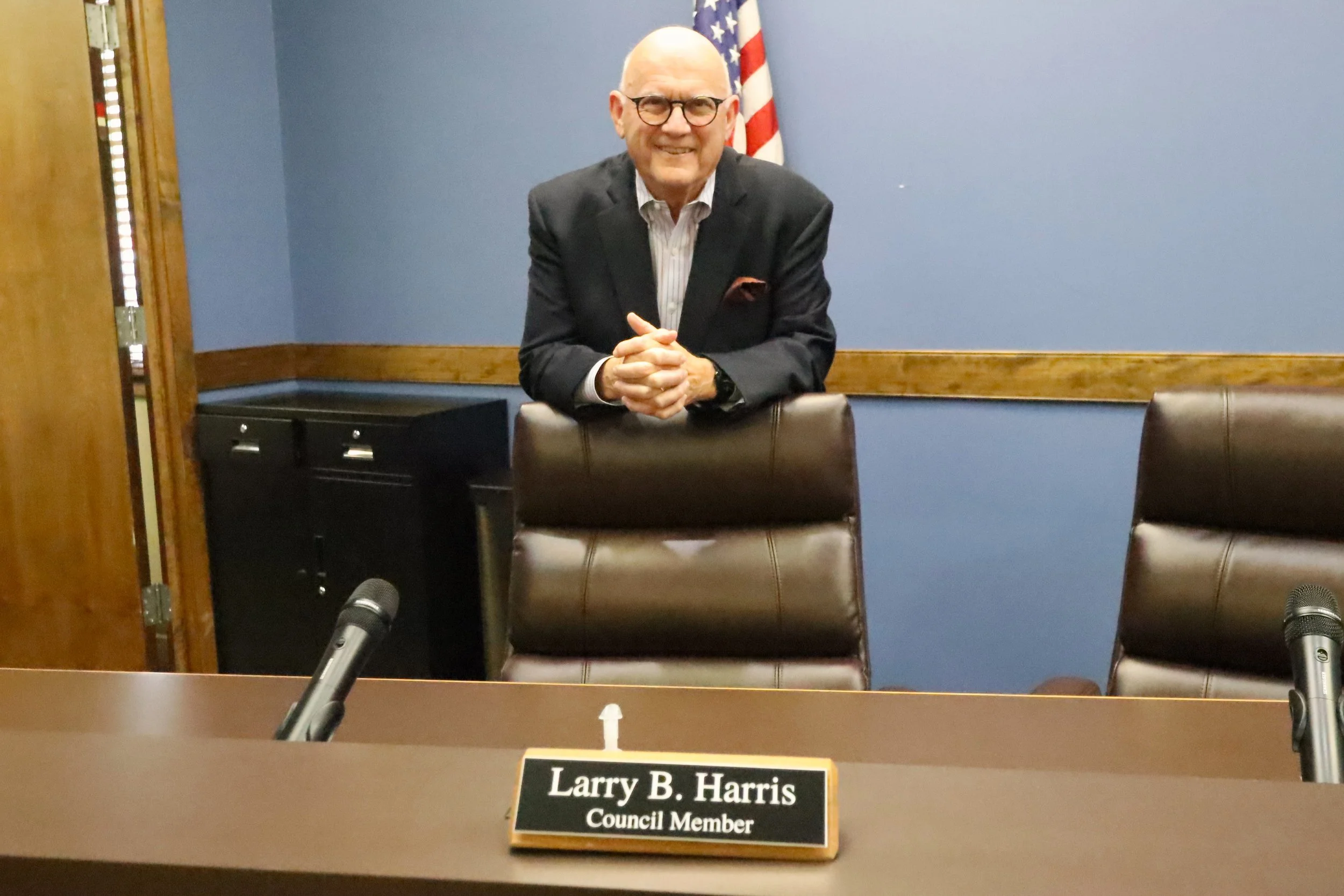
Larry Harris is one of two candidates vying to complete the final two years of an unexpired term on the Black Mountain Town Council, as the Nov. 3 election approaches. Photo by Fred McCormick
This profile is one of a series examining the priorities of candidates running for office in the Town of Black Mountain this fall. In-person early voting for the Buncombe County General Election will be open Oct. 15 - 31, with election day held, Tuesday, Nov. 3.
Larry Harris is comfortable in his current role, answering the call to serve the community he has called home his entire life. His first tenure on the Black Mountain Town Council was in 1987, when the board made the controversial decision to expand through annexation.
Like all but one official who supported the move, Harris lost his reelection bid in 1989, but he was asked to serve more than two decades later, when he was appointed to fill a vacant seat on the board in 2013. He retained that seat in the election that followed, before he was appointed mayor, following the resignation of his predecessor in 2020.
Although the political career of Harris was paused in 2022, when he was defeated in the mayoral race by Michael Sobol, nearly four years later, following the resignation of Pam King, he filled another vacancy, embarking on his third tenure on the town council. When Black Mountain voters head to the polls, Tuesday, Nov. 3, to choose their local representatives, the familiar name will be back on the ballot as one of two vying for the seat.
“I had a real sense, although I couldn’t be assured, that the folks on the board desired my experience and financial expertise,” the retired certified public accountant and financial planner for more than 40 years said of his most recent return to the governing body. “At that time, I had worked with everyone on the board except one current member.”
While Harris, one of two candidates running to fill the final two years of an unexpired town council term, brought plenty of experience with his appointment last May, the landscape of the town was considerably different than when he departed four years earlier.
“The town was not in good shape,” he said of his perception upon applying for the seat he now holds. “I talked to people who I knew were closer to the town. As a former member of the council, I didn’t really think it was appropriate to be present at board meetings, but my sense was that the community engaged with town government had, for some reason, a great deal of anger.”
Accusations of poor communication, overly aggressive code enforcement and perceived hostility from town staff have become increasingly common subjects of public comments during council meetings, particularly in the past year, leading to a contentious environment, according to Harris.
“I think town staff are somewhat resentful of that,” he said. “There is certainly an unsupportive and fairly visceral perspective from some elected officials towards staff. It’s not healthy, and it’s not going to create an environment where the community or staff is proud to be in the town.”
The relationship between the public and representatives of the town is one of several significant challenges for the municipality, which is to be included on the Local Government Commission’s Unit Assistance List, a N.C. Treasurer’s Department tool that supplies resources to municipalities facing financial, operational or reporting difficulties. The announcement came less than two months after a difficult budgeting season, which the town entered facing a nearly $2 million shortfall in its general fund and an approximately $900,000 water fund deficit.
Getting up to speed
Harris was well-versed in the duties associated with serving on the town council when he returned to the dais in the middle of a difficult budget season. The municipality was under the supervision of an interim town manager, following the departure of the previous administrator and assistant town manager earlier in the year. With a nearly year-long vacancy in the town’s finance department, Harris was the first of two appointees to the council within 63 days.
“Think about what happened when Helene came in. It was so unique, and nobody had ever dealt with anything like that,” Harris said. “The town spent a lot of money bringing water in, which was really helpful. We spent money on overtime, money on bringing dumpsters in because we couldn’t pick up trash. Everybody was doing everything they could.”
The municipality was compelled to supplement expenses with money from its unassigned fund balance.
“They spent a good bit of general fund money, and that’s something that will always come back into play,” Harris said. “You have to be careful when you do that. The budget was done, to me, in such a way that they didn’t know what they were doing. It has left us in a precarious place.”
Some of that funding is in the process of being reimbursed, he added.
“It’s not a short recovery,” Harris said. “Helene happened not that long after COVID-19, and I think people were tired. Unless you have your feet firmly on the ground, it’s a lot of pressure on folks to work through all that.”
Addressing rising costs and growing demands on local government continues to be a challenge for the municipality, according to the incumbent candidate.
“We have to compensate our employees in a manner that is like other municipalities in the state,” he said. ”Times have changed. It used to be that our firemen came from Black Mountain and lived in Black Mountain. Quite a few of our policemen did, too, but it’s not that way anymore.”
A climate in which employees are publicly criticized by residents and elected officials is not conducive to a healthy work environment, according to Harris.
“When you have an atmosphere like we have right now, they don’t feel appreciated,” he said. “If an employee doesn’t feel appreciated, I don’t care what they’re getting paid, they are going to look for another job.”
Competitive compensation represents a key issue for the town, he added.
“You have to do it in an educated manner, but if you have to raise taxes to do that, that’s what you have to do,” Harris said. “It becomes part of the operating budget, so it requires you to generate more revenue, but it’s important.”
The town’s need to attract qualified candidates to fill open positions is represented in the ongoing search for a permanent town manager, according to the candidate. When the job is readvertised, following the election, Harris will focus on several core qualities he believes would serve the town.
“Obviously, competency in the basics is kind of a given. You have to be able to manage a budget; you have to be able to manage your staff,” he said. “I think honesty and trustworthiness, which kind of go hand-in-hand, are very important. You need to know you can take them at their word, because it can be easy in this environment to tell one person one thing and it’s not quite the same as what you tell another person.”
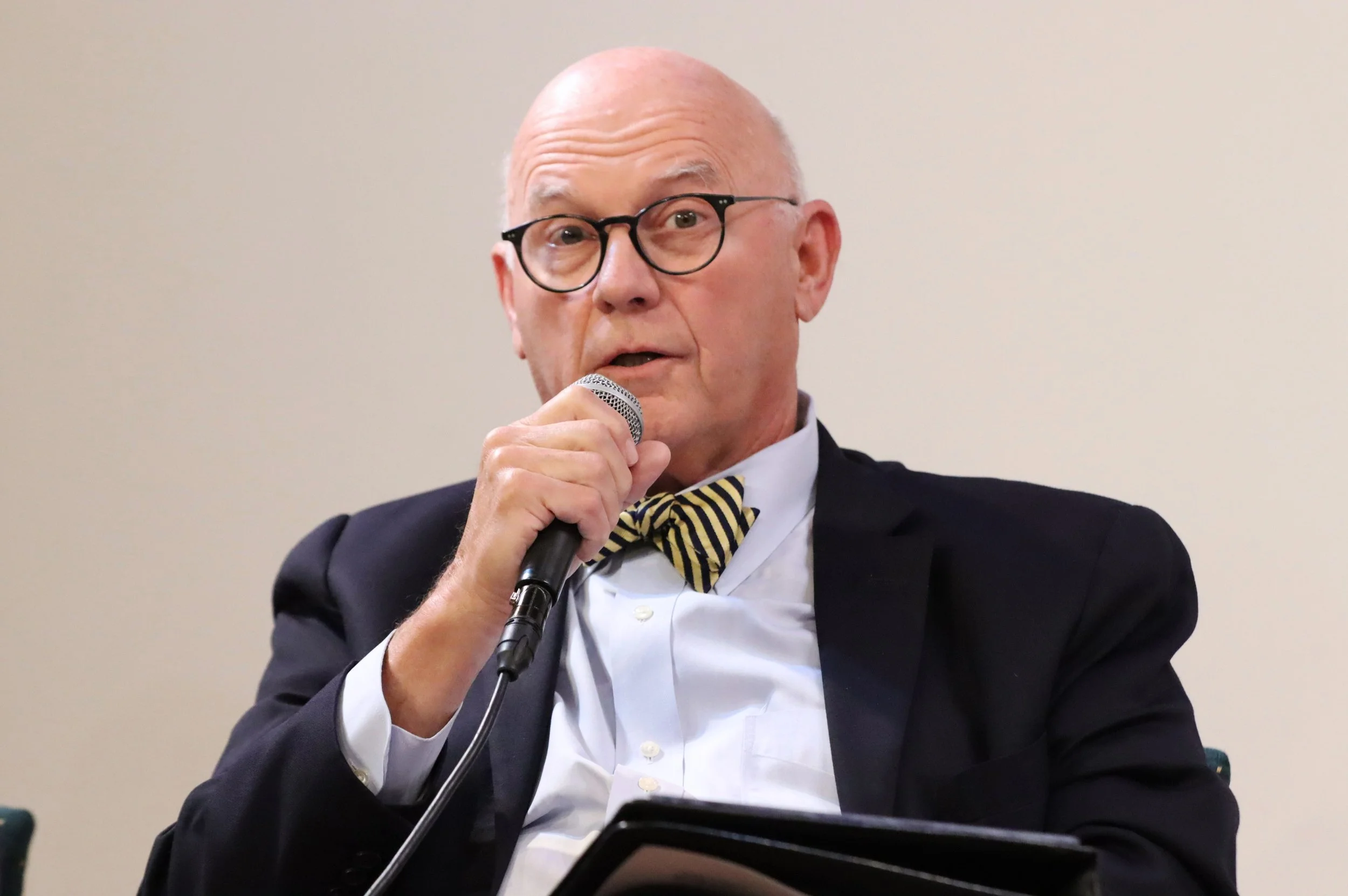
Larry Harris, in his third tenure on the Black Mountain Town Council, addresses voters, Sept. 24, in a candidate forum presented by the Black Mountain Swannanoa Chamber of Commerce. Photo by Fred McCormick
What’s best for the town
An atmosphere beset by financial challenges, damage to critical infrastructure and tension between the public and town staff is not always easy to navigate, but Harris approaches his role on the council with a simple mantra.
“It’s not about me; it’s about what’s best for the town,” he said. “To be honest, it’s been a pretty difficult situation. We had the hurricane come in, which I think rocked a lot of people off their feet.”
The council member was surprised to see a printout of 41 pending capital projects when he returned to the board five months ago.
“I thought, ‘why haven’t they seen anything like this before?’” Harris said. “That’s pretty startling.”
As issues, including the relocation of the fire and police departments away from the deteriorating public safety building, were been presented to officials, Harris was compelled to attempt to complete his current term.
“I felt satisfied in serving, and continuing to serve with Councilmember (Archie) Pertiller, Jr., Deon Lytle, Ryan and whoever fills the other two seats was something I was comfortable doing,” he said.
If elected, Harris hopes to provide guidance as the town explores long-term options for a public safety facility.
“At the end of the day, I think we have to move forward with relocating to the property that was conveyed to us by the state. We can’t afford that, and few municipalities our size could. That money has to come from government grants,” he said. “We still need a presence downtown, but they need a place, and that location will work.”
Fiscal discipline, Helene recovery and improved relationships
Moving Black Mountain into a positive direction will require three things, according to Harris: fiscal discipline, remaining disciplined with Helene recovery and improving relationships between town staff, elected officials and the public.
“All of those things will help,” he said. “I think we’ve gotten to a low point, and I believe having the Local Government Commission put us on the Unit Assistance List is a good thing. We needed to be on a list.”
He points to the recent hiring of a finance director as one step in a positive direction. Harris is offering his own professional background in accounting, financial planning and previous experience on the town council as the municipality navigates a challenging path ahead.
He credits interim town manager Richard Hicks for bringing stability to town hall.
“Richard has been very helpful in creating some peace there,” Harris said. “I’d like to see the board keep building on that, even after the election, no matter who gets in.”
Prioritizing a respectful and productive dialogue will allow the town to increase its focus on financial obligations and repairing or replacing crucial infrastructure.
“I like to give a fair ear to those who deserve it, and even to some who don’t, I do the best I can,’ Harris said. “Sometimes, you get to the point where you can’t even do that because folks are angry, and you can’t really get anywhere with them.”
The incumbent will rely on his experience to offer a stabilizing presence on the town council, if elected in November.
“I ask for a vote based on my experience, which anyone can ask more about from the people who have worked with me,” Harris said. “My professional expertise is also something I bring to the council, and I am willing to listen. The town council is a conduit for communication with the town when people have problems, and that is work I believe my record shows I am more than willing to do.”