
Town of Black Mountain remains uncertain about status of public safety building
Elected officials request additional information on viability of current police and fire facility
Fred McCormick
The Valley Echo
August 7, 2026
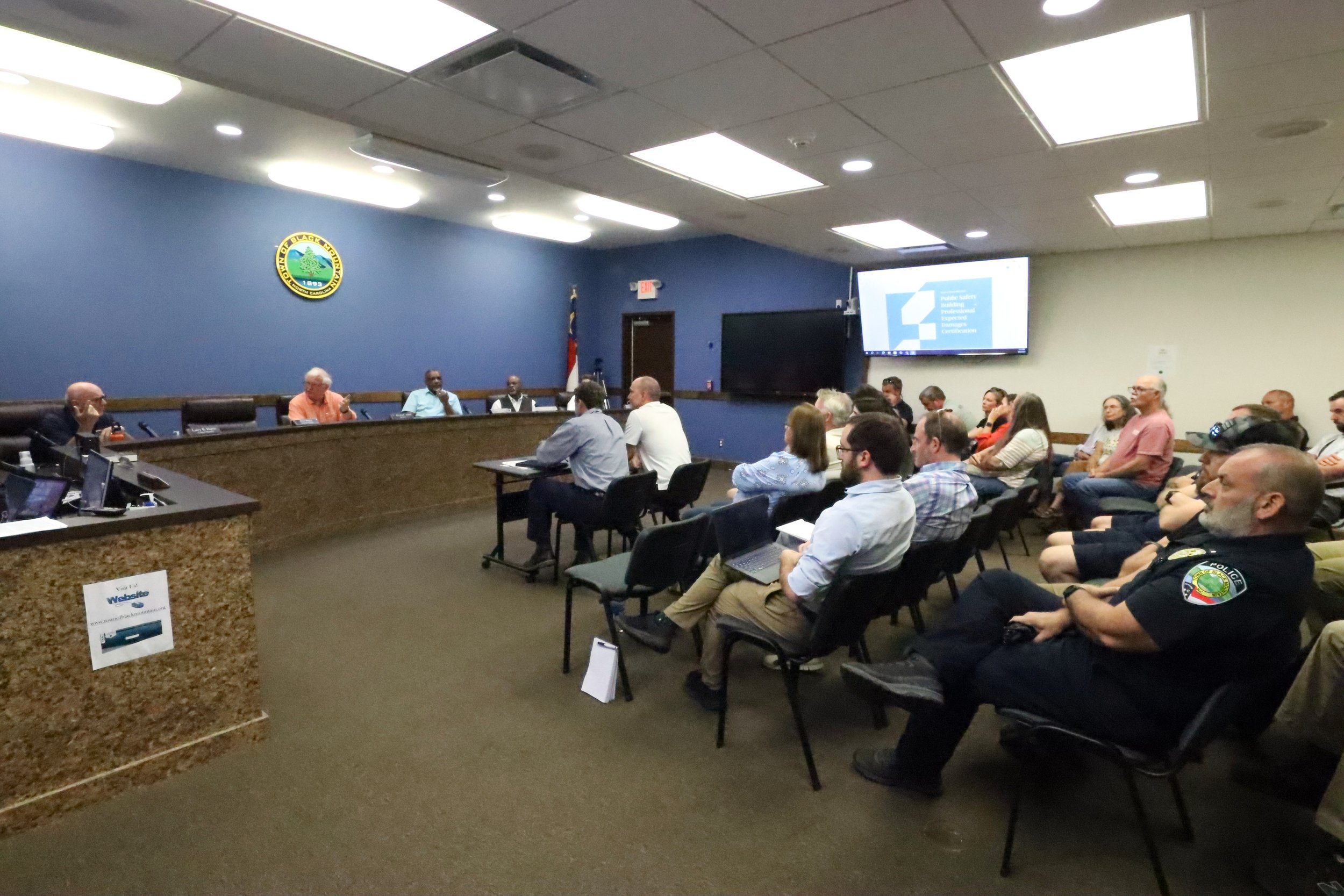
The Black Mountain Town Council meets, Aug. 6, to consider the future of the municipality’s public safety building. Photo by Fred McCormick
A special called meeting of the Black Mountain Town Council, Aug. 6, ended with more questions than answers for elected officials considering the future of the municipality’s public safety building, which housed the fire and police departments until their relocation last March, due to concerns regarding the integrity of the structure.
The proceeding, held prior to the board’s agenda meeting, included a discussion of the facility’s existing condition and a proposal to construct a $20 million 23,000-square-foot replacement on North Fork Road, while the council requested additional information to determine the cost of repairing the existing building.
Ben Cathey, a representative of Asheville-based engineering and consulting firm McGill Associates, and Kevin McDade, of Greenville-based architectural firm Mosely, initially presented a Public Safety Building Facility Condition Assessment, March 9, to the town council. The report followed a visual evaluation of the condition of the building systems, estimated the remaining the usefulness and developed a 10-year capital improvement plan based on the observations.
The assessment examined the floors, roof, walls, mechanical and plumbing systems, estimating total deferred maintenance costs for the structure to be over $2.2 million. Mosely calculated a Facility Condition Index assigning a “high-priority condition” to scores over 0.30, rating the Black Mountain public safety building 0.77.
The firm recommended the town contract a geotechnical firm to test the soil beneath the structure, after noting settling of the ground under the slab. Public safety personnel were temporarily relocated, with the fire department bay remaining in use until additional recommendations for potential repairs could be presented.
Core samples, extracted in May, found water within approximately 18 inches of the concrete beneath the building, McDade told the town council in the follow-up meeting.
“Of course, we couldn’t determine where, exactly, the water was coming from, but there is a storm pipe going through there and the closer you got to the pipe, the higher the water was,” he said. “There are seasonal variances, so if you were to monitor that every two weeks that water level could change.”
Remediating the issue would require the town to move the storm pipe from beneath the structure, redirect the flow of water and dry the soil. The method would require stabilization of the ground and additional monitoring to ensure moisture did not intrude from a different source.
Interim Town Manager Richard Hicks asked if it was possible to repair the structure.
“Anything can be repaired. As to what degree and how long, that would be the questions,” McDade said. “I don’t know the exact cost, because it’s underground and we can’t see exactly what needs to be done.”
The facility condition assessment cited the collection of core samples for the purpose of determining the extent of the impact on the soil, identifying and repairing cracks in the pipe under the structure and repairing the slab, walls and ceiling cracks as “high-priority” recommendations.
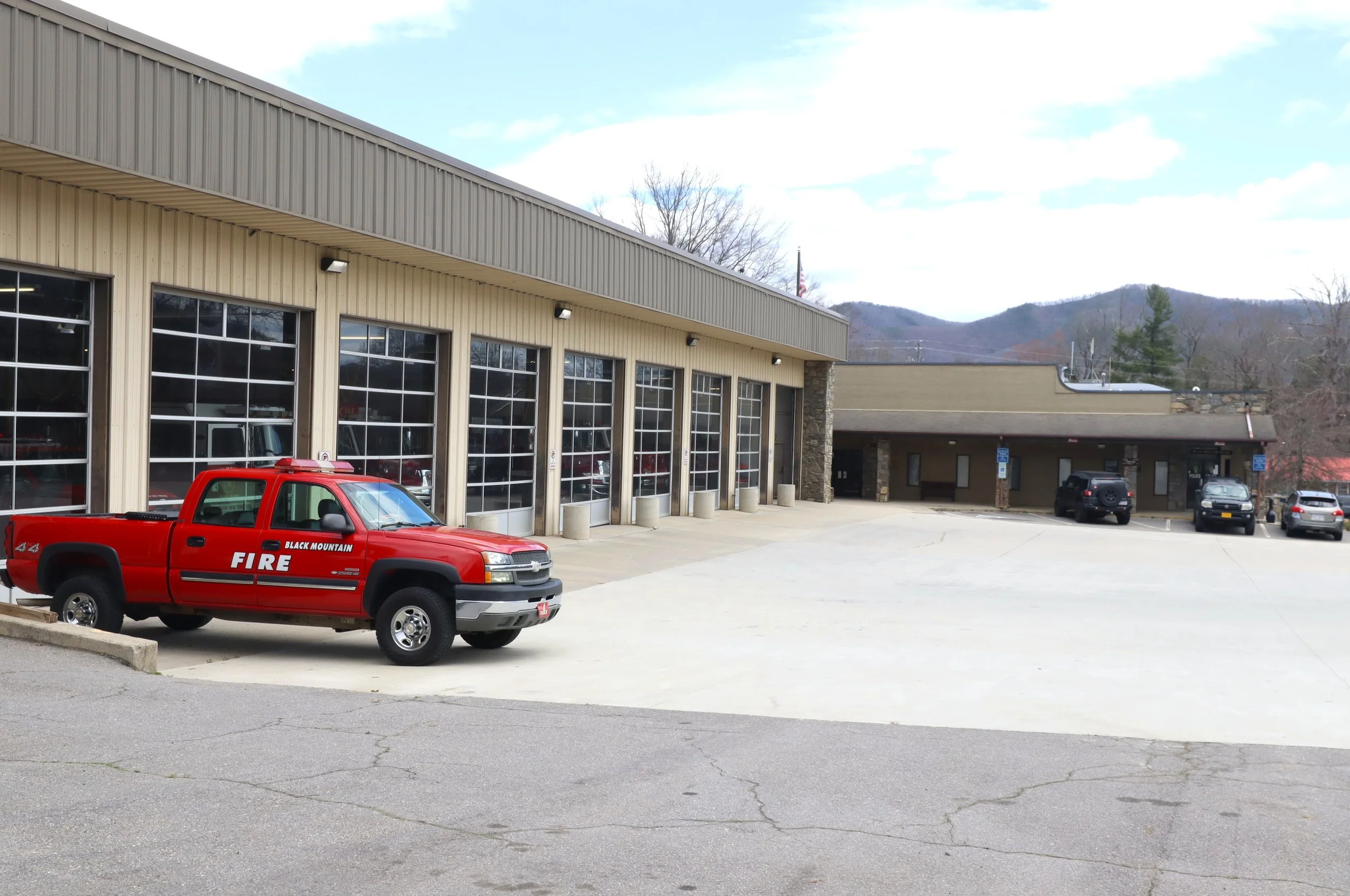
The Town of Black Mountain is seeking additional information about the viability of its current public safety building, following the temporary relocation of the fire and police departments last March. Photo by Fred McCormick
The full report, however, has not been thoroughly reviewed with the town council.
“Our frustration is that we are pursuing all these different avenues of funding at this point,” Councilmember Ryan Stone said. “We really need some direction, and the public needs to hear that direction, as to what our options are, and what we can do.”
What is known, according to Cathey, is “there is something going on underneath that building that are problematic.”
“Solving those will be very difficult,” he said. “With a stream under it, those are not easy problems to fix. Just running a pipe around it is not going to fix that problem.”
Additional information is needed before elected officials can determine how to proceed, Mayor Michael Sobol said.
“This board can’t make a decision unless it sees, either this building can be fixed or can’t be fixed,” he said. “If it can be fixed, this is the way it has to be fixed: A, B, C, D, E, F, G. It will cost $1 million, $2 million, $3 million.”
A design and estimate to repair the existing structure would require a “detailed analysis,” Cathey responded.
“At some point, we have to determine whether that is throwing good money after bad,” he said. “That’s the gist of this report.”
The facility condition index rating in the assessment indicates “significant capital investment” will be required to improve the building, with a cost of demolishing and building a replacement of a similar size is estimated around $8 million.
“So what is the next step?” Councilmember Larry Harris queried. “We have a condition assessment, and there is no action expected to be taken tonight, just information gathering. I’m a little lost on what we’re trying to do here tonight.”
Sobol advocated authorizing the interim manager to contract a structural engineer to assess the integrity of the building.
“I thought we were at a point where you, as an architect, would be in a position to say the cost to fix the problems far exceed the value of the building,” Hicks said. “It sounds like we’re not at that point.”
Town officials, according to the Mosely representative, would need to determine how much funding the municipality is willing to allocate for the purpose of remaining in the building. The interim manager asked the presenters to offer a “reasonable path forward.”
“I’m not sure we’re at a point where we’re making any progress at all,” Hicks said.
Black Mountain Police Chief Steve Parker interpreted the purpose the meeting as a presentation of the core samples and a potential new location for a public safety building.
“What we’re in fear of is this can keeps getting kicked down the road…” Parker said. “That's where it’s frustrating to us, and difficult.”
Harris asked Hicks to meet with the consultants and determine possible options.
“You’re probably going to have to work with the town manager to get us to a next step so we can have enough information to know what the cost is to repair the building or if, in your assessment, it can’t be done,” Harris said.
The town council directed Hicks to gather estimates for the necessary repairs.
“Can it be salvaged, or can it not?” Vice Mayor Archie Pertiller, Jr. said. “That’s what we need to know.”
The meeting continued with a proposal to construct a new police and fire facility on North Fork Road, as the town applies for funding through the federal Building Resilient Infrastructure and Communities (BRIC) program. The two-level design, planned for the west side of town, includes separate access for the fire and police departments.
“We’ve been looking at all the grant funding, congressional funding and state funding we can get to lessen the burden on taxpayers,” Parker said. “That’s been our main goal, which is how do we get where we need to be.”