
Thomas Chapel tour explores historical significance of prominent local landmark
SVM Echoes of the Valley series To take Guests inside hallowed sanctuary
Fred McCormick
The Valley Echo
June 1, 2026
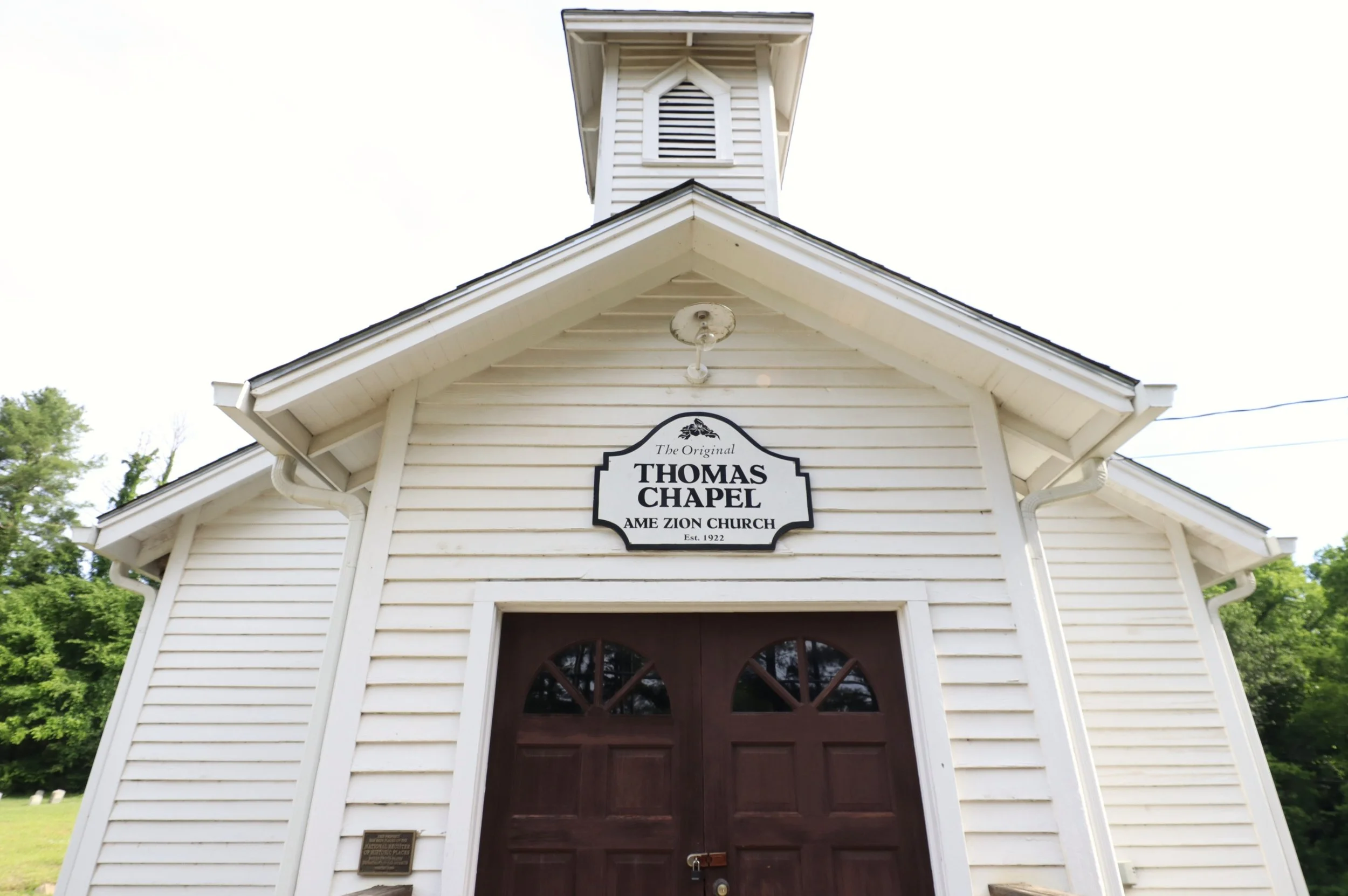
The Swannanoa Valley Museum will offer a tour of the Original Thomas Chapel AME Zion Church, June 3, as part of its Echoes of the Valley series. Photo by Fred McCormick
The Gothic Revival wooden structure sitting atop a hill overlooking Cragmont Avenue, on the west side of Black Mountain, has been a well-recognized local landmark for over a century. However, the humble character of the house of worship, measuring approximately 1,800 square feet and topped with a prominent bell tower, belies its historical significance.
The story of Thomas Chapel A.M.E. Zion Church will be revisited, beginning at 2 p.m., Wednesday, June 3, when the Swannanoa Valley Museum & History Center brings its Echoes of the Valley tour to the hallowed property, including the surrounding Oak Grove Cemetery.
In the decades after the Civil War, many freed men and women of the settlement then known as Grey Eagle chose to remain in the region their ancestors called home for well over a century. By 1892, months before the Town of Black Mountain was incorporated the following March, Miles H. and Martha Stepp donated a one-acre parcel of land to the trustees of James, Daugherty, Ann Daugherty and Emmaline Lytle for the establishment of a church. Logs were hauled from the Lytle Cove community to construct “Tom’s Chapel,” which was named in honor of founders Tom Pertiller and Thomas Daugherty, as the first black church in the Swannanoa Valley.
While the precise location of the first structure is unknown, the Methodist sanctuary was utilized by Baptist congregations on alternating Sundays, until the construction of nearby Mills Chapel Baptist Church in 1910.
Construction of the Original Thomas Chapel A.M.E. Zion Church was completed in 1922, as noted on the cornerstone in the southeast quadrant of the foundation. Under the leadership of Reverend W.R. Lovell and local leaders Ervin Kennedy, Thomas Lytle and Ed Stepp, the building was erected near a cemetery that holds the remains of the town’s pioneering black families. Five years later, the location was selected to host the Blue Ridge District Denominational Conference, attended by representatives of approximately two dozen regional churches.
For the next 50 years, prior to the construction of a larger space on West College Street, Thomas Chapel served as a community center for the historically black neighborhood along Cragmont Road. Throughout the Jim Crow era, the sanctuary hosted social gatherings, singing conventions, community speakers of all races and the school plays produced by students of Clearview Grammar School, which was established with funding from John Myra Stepp, who was emancipated when he was around 15 years old.
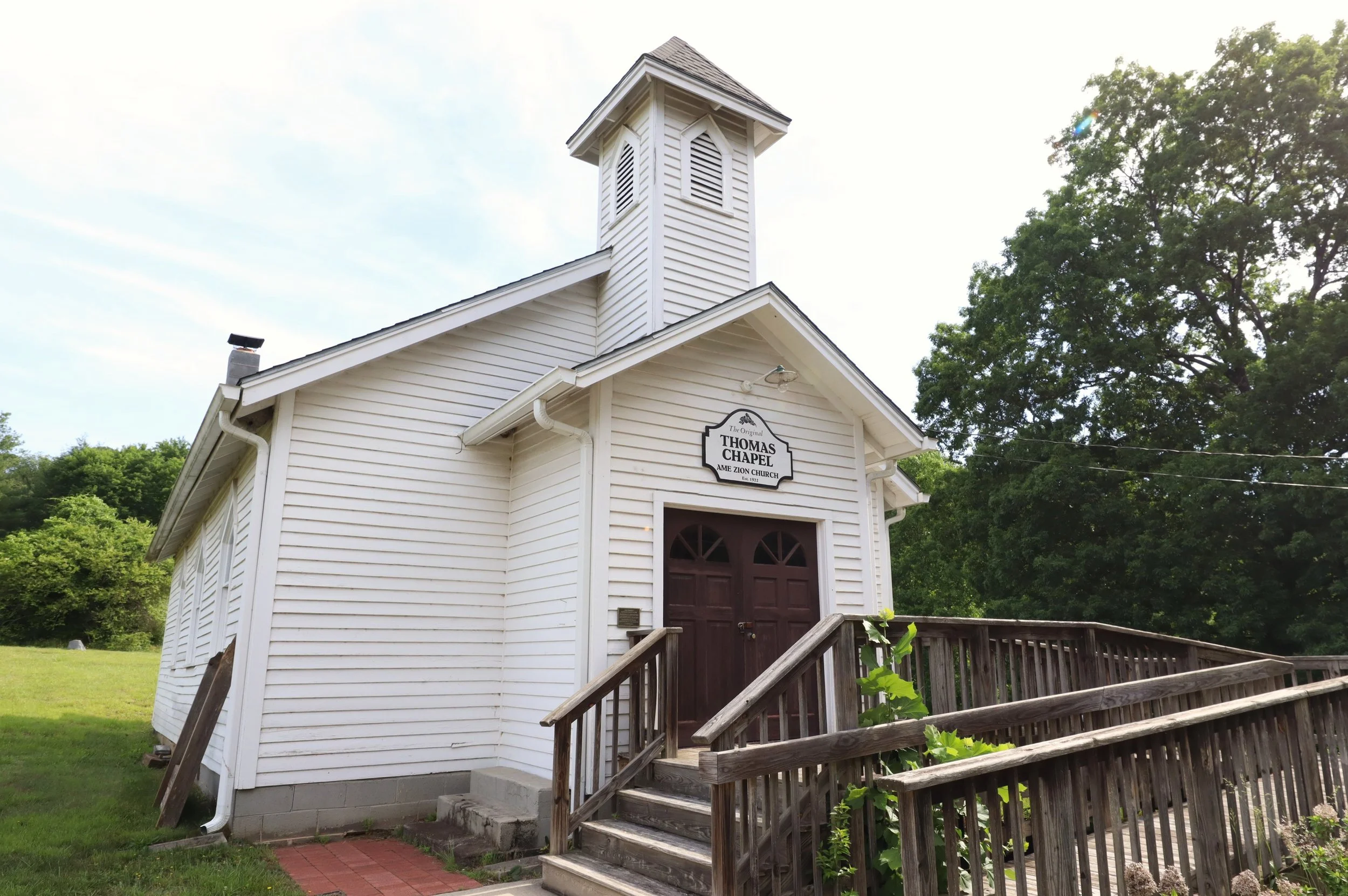
Built by the descendants of freed men and women, Thomas Chapel was listed on the National Register of Historical Places in 2009. Photo by Fred McCormick
John Myra, who lived to the age of 105, was one of at least 10 offspring of Grey Eagle slaveholder Joseph Stepp and Myra, a woman he held in captivity. Upon emancipation, without inheriting land from their father, Myra’s sons went on to successful ventures as farmers, carpenters, contractors, masons, grave diggers, loggers and railroad workers in their native community. The women of the family included Mary Louisa Stepp Burnette Hayden, who was born to an enslaved woman, Hanah, on the Stepp plantation in 1858. Hayden, who lived to be nearly 100 years old, was a renowned midwife and herbalist who delivered hundreds of black and white babies, becoming one of the first African American women to be officially registered with the Buncombe County Health Department.
Both Hanah and Myra were believed to be of African and Native American descent.
Other Stepp offspring included Ed, who was born in 1865, before later working on a crew of 14 men that constructed much of the infrastructure in the Church Street neighborhood. A writer and journalist, Ed, who is buried next to his wife Hattie just feet from the Thomas Chapel entrance, penned a series of articles for The Black Mountain News when the local newspaper began publishing in 1945.
The congregation fully vacated the church in 1984, with the structure falling into disrepair in the decades that followed. In 2007, the church trustees deeded the property to the Original Thomas Chapel A.M.E. Zion Church Restoration Corporation, which, with the support of local volunteers, preserved the structural integrity of the building. The beadboard ceiling and heart pine floors were replaced, transforming the landmark into a living museum.
The chapel, noted as an outstanding structurally intact monument to African American vernacular architecture, was officially listed on the National Register of Historic Places in 2009.
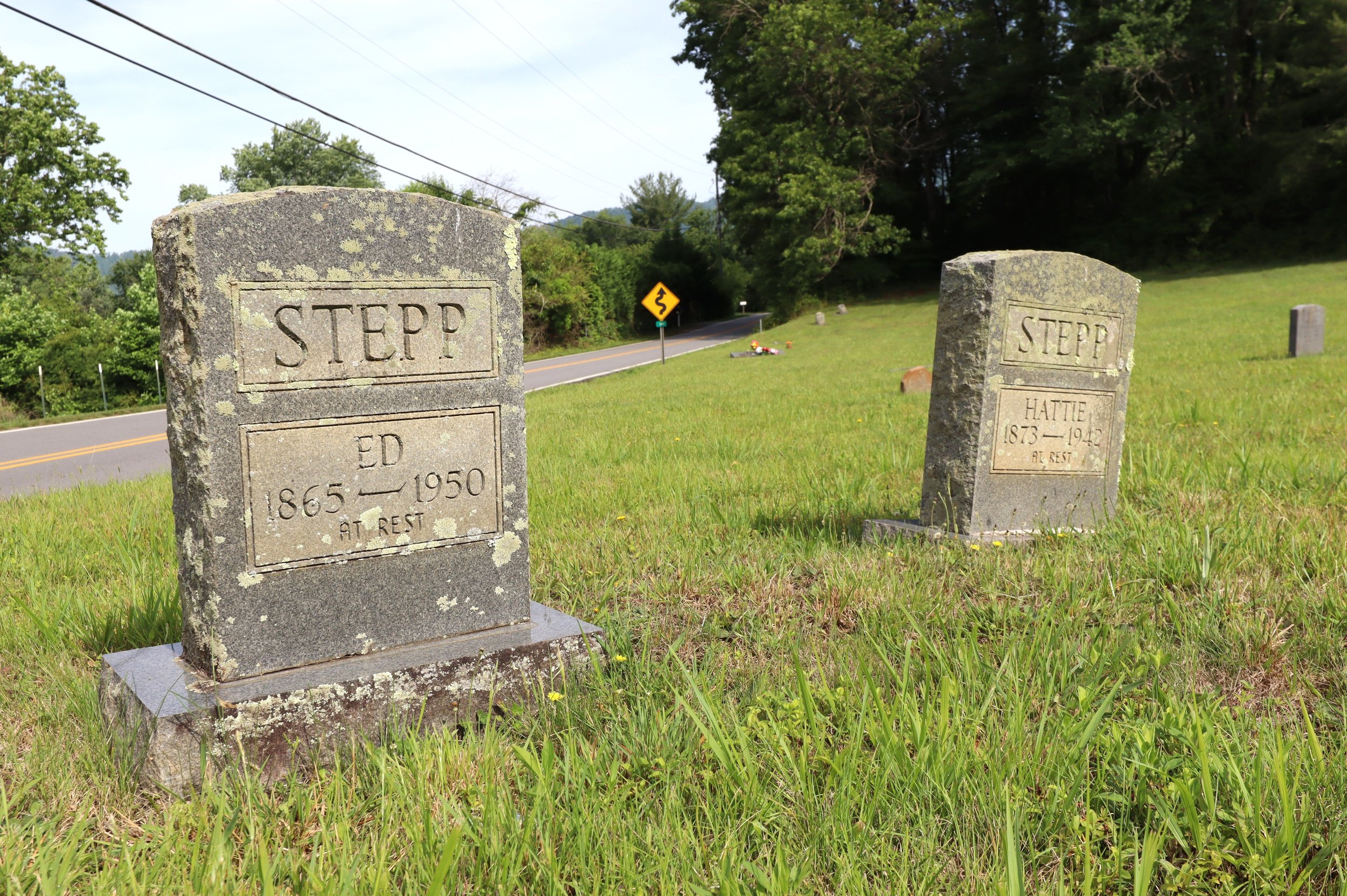
Oak Grove Cemetery, which surrounds Thomas Chapel, serves as the final resting place for many of the pioneering black families of the Swannanoa Valley. Photo by Fred McCormick
Thomas Chapel is among eight historically significant sites on the SVM’s Echoes of the Valley tour, which will includes visits to the In-the-Oaks Estate, Point Lookout, Kitsuma and Riceville, before concluding with a driving tour of North Fork in October.
The tours are designed to provide an accessible forum for local residents interested in learning more about the history of the Swannanoa Valley, according to SVM director LeAnne Johnson.
“We selected historical churches, cemeteries and estates that the public normally does not have access to,” she said. “Each tour brings to light a little more history of the Swannanoa Valley.”
Tickets for the upcoming tour are priced at $25 for SVM members and $30 for nonmembers, and can be purchased at swannanoavalleymuseum.org. Reduced fees are available through the nonprofit museum’s “Pay-As-You-Can” option, which allows members and nonmembers to purchase tickets at a reduced cost.
“There has been a growing trend in Buncombe County for pay-as-you-can events that allows them to be accessible to all walks of life,” Johnson said. “We felt, as did the board, that we should start offering that option for events that do not cost a lot to organize. We want to make sure that these historic places are available to everyone in our community, not just people with means.”
Each tour will be led by local historians and museum partners, with Thomas Chapel Board of Directors member Lyn Vanover offering historical background on the subject.
“This is one of the first African American churches in the area built by freed slaves, and that alone makes it a significant landmark in the Swannanoa Valley,” Johnson said. “It’s important that we keep these places of heritage in people’s minds, because if we don’t do that, we’re doomed to repeat history. Remembering what came before us allows us to make better choices for our future.”