
Swannanoa Valley Black History Project preserves legacies of local communities
Elders share stories and reflect on gentrification of historically Black neighborhoods
Fred McCormick
The Valley Echo
November 23, 2026
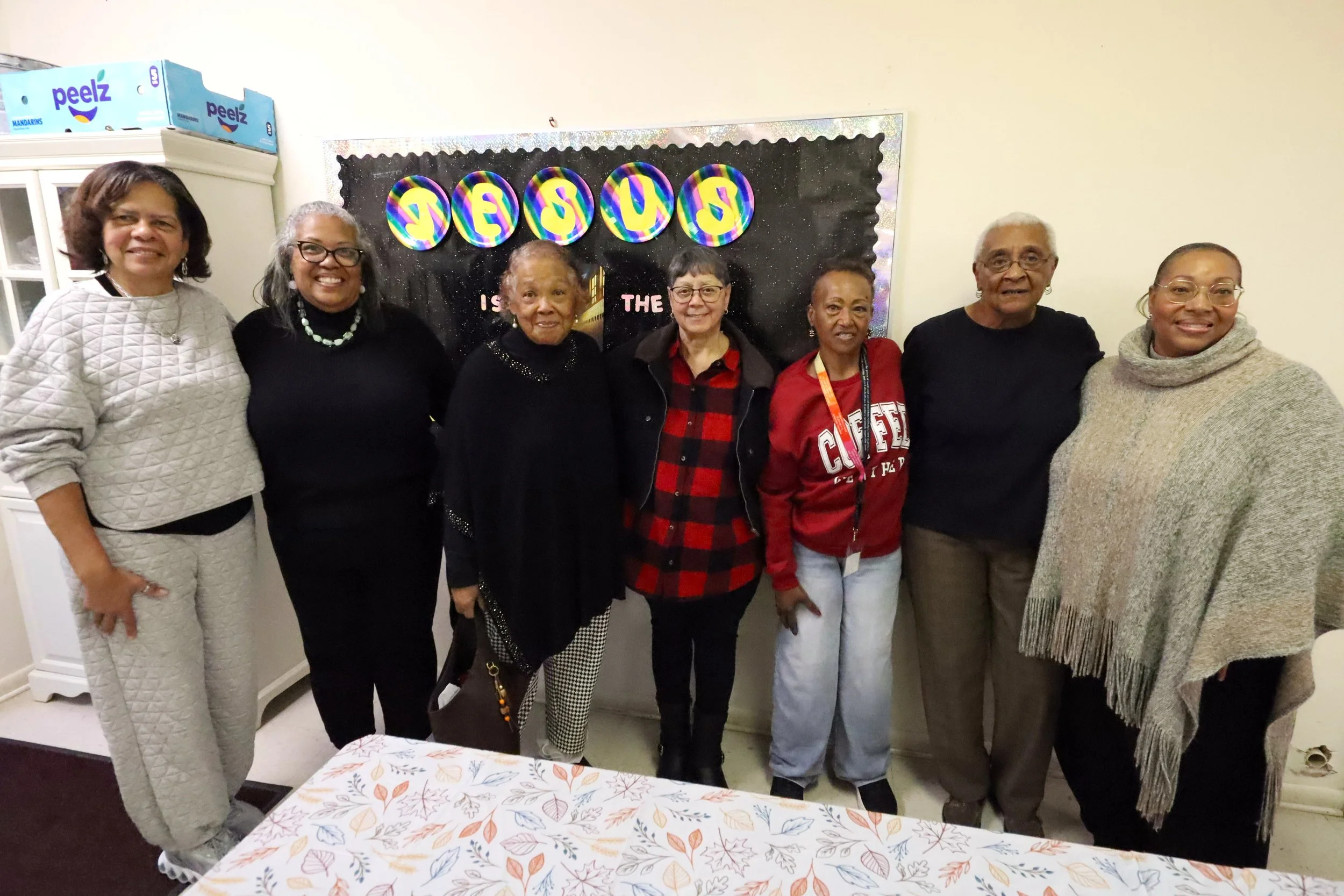
From left to right, Beverly Gardner, Melody Gardner, Doris Gardner, Cora Stafford, Rochelle Daniel, Barbara Hawkins and Naomi Logan-Smith participate, Nov. 21, in a panel discussion marking the debut of the Swannanoa Valley Black History Project. Photo by Fred McCormick
Growing up in Black Mountain, Rochelle Daniel was greeted by familiar and friendly faces on her regular strolls through the neighborhood she called home.
“I grew up at a time when Cragmont Road was a Black community,” the 68-year old Black Mountain native said. “Cragmont has been in my life forever. My grandparents had homes there, my aunts and uncles did too, and people who weren’t my grandfather and grandmother, I called grandparents. I knew everybody on Cragmont Road.”
The neighborhood was once one of several predominantly Black communities in eastern Buncombe County, where the Swannanoa Valley Black History Project, an initiative sponsored by four nonprofit organizations, is working to preserve the rich heritage and history established by generations of local residents.
Co-sponsored by the Swannanoa Valley Dr. Martin Luther King, Jr. Memorial Corporation, Swannanoa Valley Museum & History Center, the Original Thomas Chapel Restoration Foundation and the Asheville Museum of History, the collaborative effort debuted “Stories and Reflections: Local Black Elders Speak,” Nov. 21, in the crowded fellowship hall at Mills Chapel Baptist Church. The first in a series of programs focused on the impacts of redlining and gentrification.
Witnessing her former neighborhood become nearly unrecognizable has been a painful process for Daniel.
“When I come to this church, I go down to the other end so I don’t have to come up Cragmont, because it’s not the same. I know maybe two families,” she said. “It makes me sad, because the community used to be like one big family.”
Daniel was one of six Swannanoa Valley natives who shared memories growing up in the area during the forum, which was led by SVMLK Memorial Corporation board member Melody Gardner.
“We start our series discussing properties and neighborhoods in the Valley, especially five neighborhoods that were predominantly, if not 100%, African American,” Gardner said, highlighting Cragmont; the neighborhood around Padgettown Road, East Street and a section of Flat Creek Road; Old Buckeye Cove; Jordan Road and Old Lytle Cove. “These five neighborhoods have been there for over 100 years, and some for more than 110 years.”
Beverly Gardner has lived in Buckeye Cove from more than six decades, while her family has lived in the community since the 19th century.
“My dad was 96 years old when he passed away, and I remember back when my grandmother lived up above us,” said the 63-year-old Swannanoa native. “I have lived there all my life, so I’m guessing my family has lived there for around 150 years, but it may be longer.”
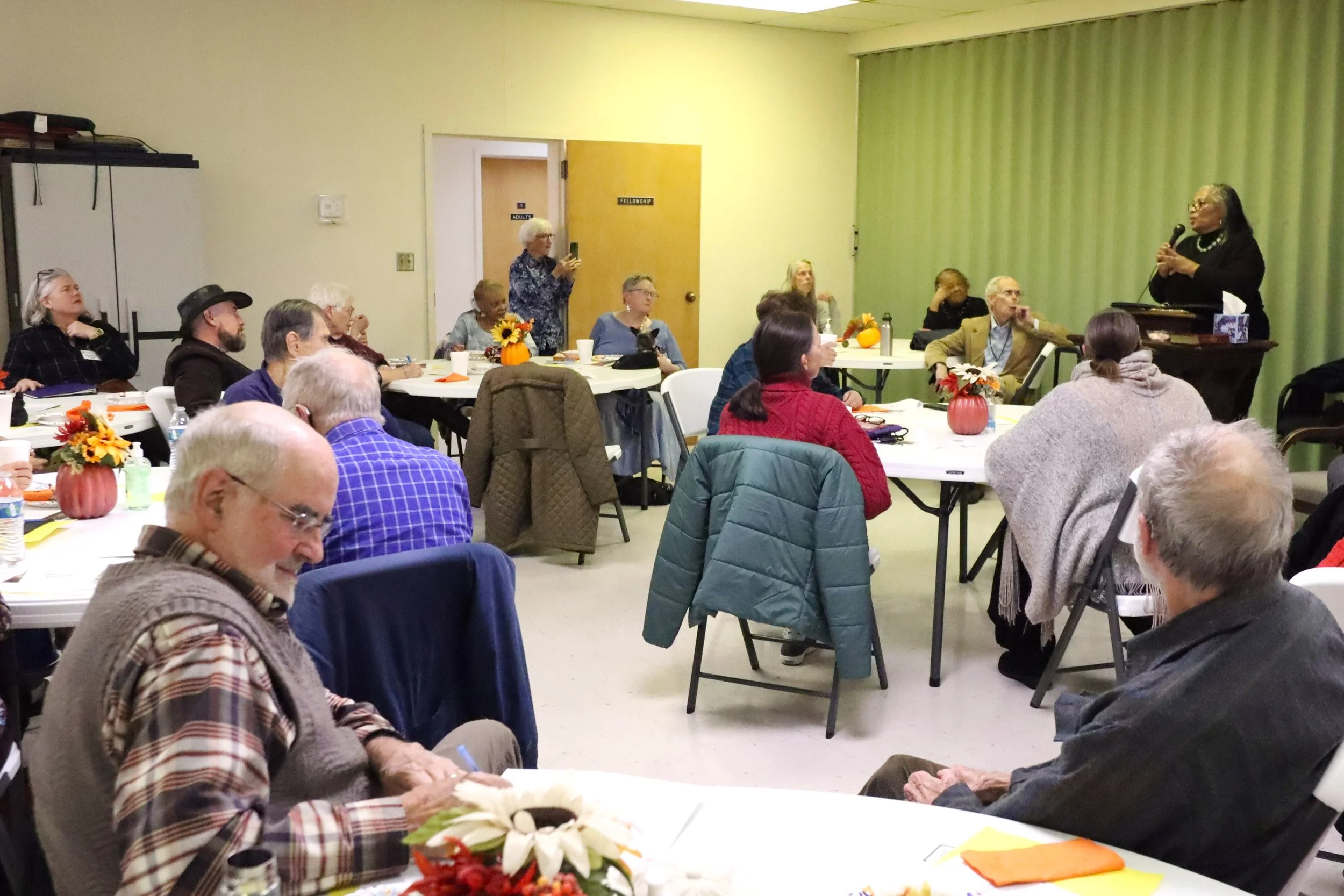
Melody Gardner leads the first of the Stories and Reflections series, presented by the Swannanoa Valley Black History Project. Local Black Elders Speak: Properties and Neighborhoods was held, Nov. 21, at Mills Chapel Baptist Church. Photo by Fred McCormick
Colonel Samuel Davidson, recognized as the first European settler of the Swannanoa Valley, arrived in the area around 1784, with his wife, infant daughter and an unnamed enslaved woman, who was later identified by a descendant as “Liza.” Sarah Gudger, a formerly enslaved woman who was reportedly 121 years old when she was interviewed for the Federal Writers Project in 1937, is buried in a cemetery at New Salem Missionary Baptist Church in Swannanoa. John Myra Stepp, born into chattel slavery near the center of Black Mountain before his emancipation as a teenager, funded the first school for Black children in the community, becoming a prominent land and business owner before his death at 105 years old in 1955.
The purpose of the Swannanoa Valley Black History Project, according to SVMLK Memorial Corporation board member Jim Abbott, is to "trace, embrace and celebrate the rich heritage and contributions of Black residents” in the area.
In the coming weeks, the program will launch an interactive Black History Trail digital map, highlighting significant cultural sites, from the property that once housed Roseland Gardens, a Black-owned juke joint that operated as an integrated venue for live music, dancing and entertainment for 60 years, throughout the Jim Crow era, to the settlement once occupied by Liza and the Davidson family. Other locations include the former George Washington Carver School, currently home to a Montessori school and afterschool program, which operated as a segregated school for Black students until 1966.
“We don’t want history to be something that happened back then, and just something on paper,” Abbott said. “We want to make it known that this is a living reality, and there are a lot of people here in this community who have lived much of this, and written a lot of it."
The Stories and Reflections series will provide a forum for Swannanoa Valley natives to share perspectives and insights about local communities. Doris Gardner, a panelist in the inaugural gathering, lived on Jordan Road as a child, before later moving to Black Mountain.
“I’m 79, so I’ve been over here (in Black Mountain) for more than 60 years,” she said. “I remember living on Jordan Road as a child, until I married at 18. We moved to Black Mountain to make our home. When I grew up, things were separated.”
Barbara Hawkins, 77, has lived on East Street in Black Mountain most of her life, witnessing a transformation of the surrounding neighborhood.
“The community has changed so much,” she said. “We only have two Black families on John Myra Avenue, which is named after my grandfather, five on East Street, one on Flat Creek, going towards Montreat, and one on Padgettown. All of that area used to be Black.”
The practice of redlining, in which mortgage loans and other financial services were often withheld in Black communities, was unknown at the time it was practiced, according to Melody.
“We didn’t know it was called redlining. All we knew when we were young is that white people lived over here and Black people live over here,” she said, asking panelists to share experiences of growing up in the Swannanoa Valley between the 1930s and 1980s.
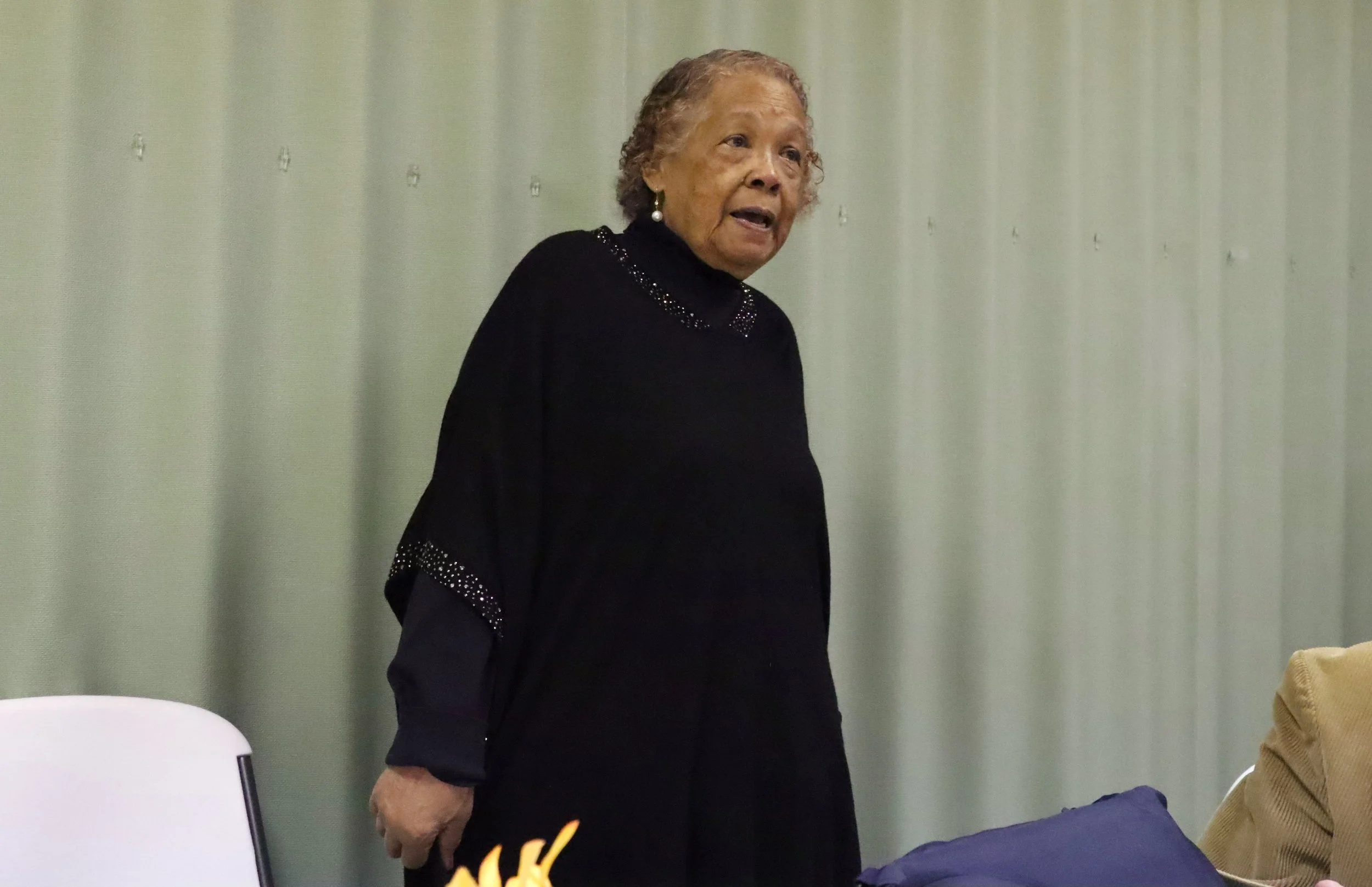
Doris Gardner, who lived on Jones Road in Swannanoa as a child before moving to her home in Black Mountain, shares stories of growing up in the Swannanoa Valley. Photo by Fred McCormick
“I’m speaking for my sister, even though she’s not here,” Beverly said. “Her and my brother Steve were the first Black students from Swannanoa to go Owen. She said she didn’t have too much of a hard time, but I think my brother did.”
Daniel began attending school at Carver as a young child, before enrolling in the county school system in second grade.
“At the time, I was 6 or 7 years old, and kids our age didn’t realize what was happening. We didn’t see color, we just saw friends,” she said. “It didn’t impact us negatively, and we didn’t completely realize certain things white kids could do, we couldn’t do.”
Socialization between all races was common, Daniel added.
“My grandmother was a nanny and housekeeper to white families, and those families brought their children to her house, so we played with them,” she said. “We had a milkman that drove a Biltmore Dairy truck through our neighborhood, and my grandmother took care of his kids.”
Her perspective changed as she became a teenager.
“We began to realize what was going on at the high school, because there was a fight every Friday night at the football games,” Daniel said. “There was a little club in town that white students were allowed to go to, but Black kids couldn’t, so there were sometimes fights about that in the middle of town.”
As a teenager living in Black Mountain in the 1980s, Naomi Logan Smith believes she lived in a “unique” environment.
“When you go to another town that’s very hierarchical and stratified by class and race, you appreciate Black Mountain,” she said. “My mother has lived here all her life, and to me, Black Mountain has always been like any kind of family. You have issues, and some of those issues are put upon you by previous generations., but you work through them together.”
Logan Smith recalled an incident in which her campaign sign was defaced with racist graffiti while she was running for student government.
“My friends wanted to ‘get him,’ and they were white. It felt like we were all family, because when you grow up in one school system, you kind of get to know each other,” she said. “I was militant during that time, because I felt there was no representation in our history books about what was happening with Black people, but over time, I’ve come to really appreciate what has been produced in Black Mountain, especially among the Black community.”
While the Swannanoa Valley is a “beautiful place” where people of all races live next to each other and socialize, according to Melody, the legacy of redlining continues to impact historically neighborhoods.
“People want to know why young Black people sold their grandparents and parents houses so people could come in and build the houses they like. It’s because there were no opportunities here, so they took that money and put towards things like fixing their own homes,” she said. “Redlining really was the catalyst to this land becoming profitable for a lot of us.”
Community conversations like the ones that will be hosted by the Swannanoa Valley Black History Project represent a key step in identifying potential solutions to the long-term ramifications of gentrification, according to speaker.
“What we all need to understand about gentrification, is redlining created the cheap land that made gentrification profitable, therefore respecting the neighborhood and original residence is critical to making gentrification successful for all of the community,” Melody said. “The original residents would have loved to have secured home improvement loans and had parks built and sidewalks laid. That was not their reality, but it’s their reality now. The original residents love their community, and the new residents love their community, too. What we must do is figure out ways the original owners who want to stay, and not sell, can afford to do so.”
For more information about The Swannanoa Valley Black History Project, visit svmlk.org/black-history-project.