
Swannanoa River Floodbench Project reshapes half-mile of damaged waterway
Town of Black Mountain completes first phase of $5 million flood mitigation and stream restoration project
Fred McCormick
The Valley Echo
October 30, 2026
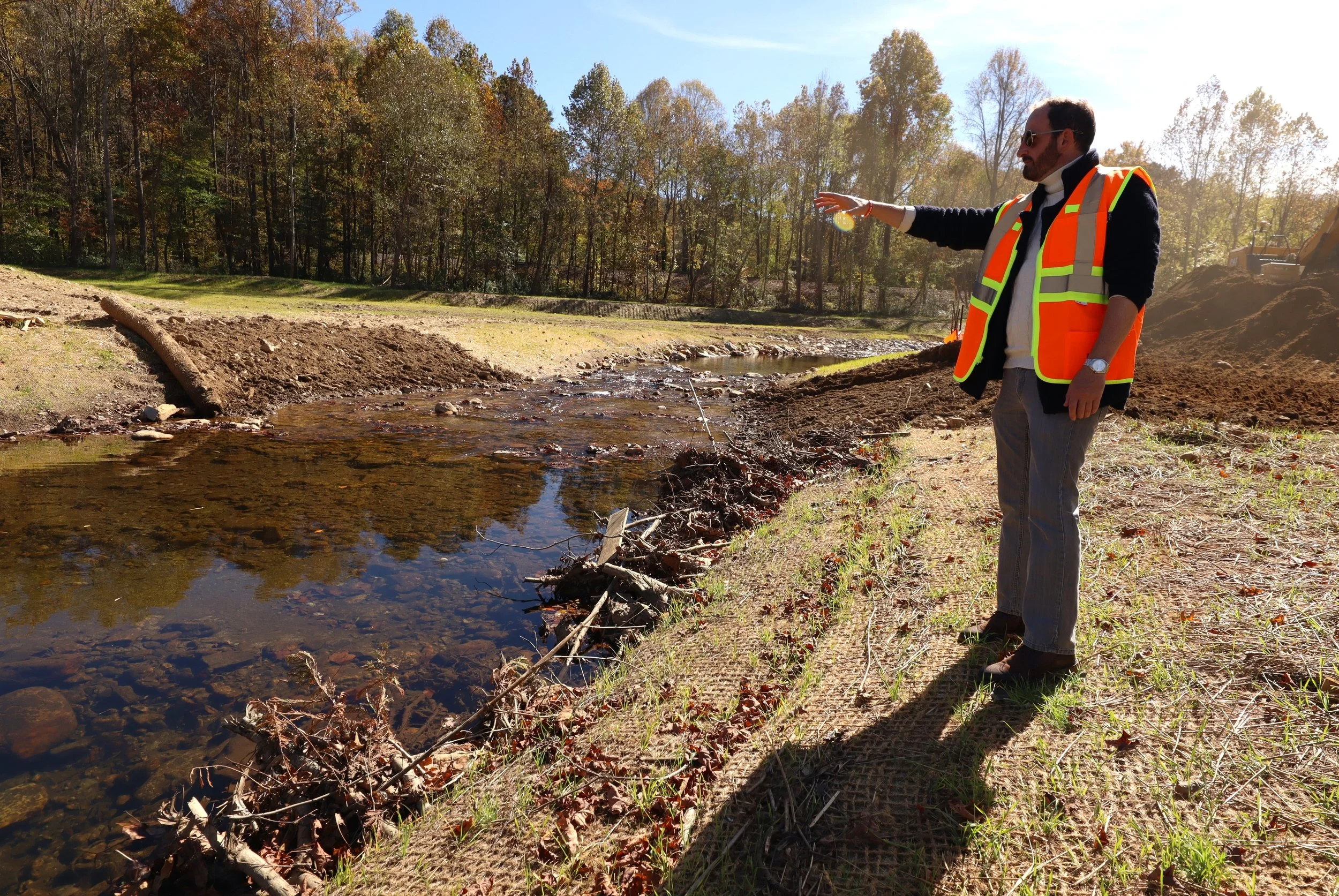
Town of Black Mountain interim project manager Chad Goins examines a section of the Swannanoa River Floodbench Project, which will reshape and restore more than half a mile of the waterway. Photo by Fred McCormick
Near the confluence of Flat Creek and the Swannanoa River, waterfowl float along the gentle current, as trout and other native fish species dart between smooth stones on the river bed. The tranquil setting, east of downtown Black Mountain, offers a glimpse into the near future of more than half a mile of the waterway that flows southwest from the site.
With the first phase of the $5 million grant-funded Swannanoa River Floodbench Project complete, the Town of Black Mountain is continuing the flood mitigation and streambank restoration initiative south of the nearby railroad tracks. The project, anticipated to be completed by the end of the year, is reshaping and rehabilitating 2,800 linear feet of the waterway.
Funded through the N.C. Department of Environmental Quality’s Local Assistance for Stormwater Infrastructure Investments (LASII) program, the Swannanoa River Floodbench Project, spanning from Hemphill Road to River Walk Park, north of I-40, addresses a need that predated Helene, according to Chad Goins, interim project manager for the Town of Black Mountain.
“There were a lot of trees and debris along the river and some sharp turns that caused water to build up at certain points,” Goins said. “It was already clear the town needed to figure out a way to address the stormwater runoff in this area.”
The town was notified of intent to fund the project, which includes three separate projects identified in the 2022 Black Mountain Stormwater Master Plan, in 2023, before the natural disaster in September of the following year drastically altered the landscape.
“The storm rerouted the river,” Goins said. “We had an engineering plan for this project that existed prior to Helene, but it had to be completely redone because the river itself moved.”
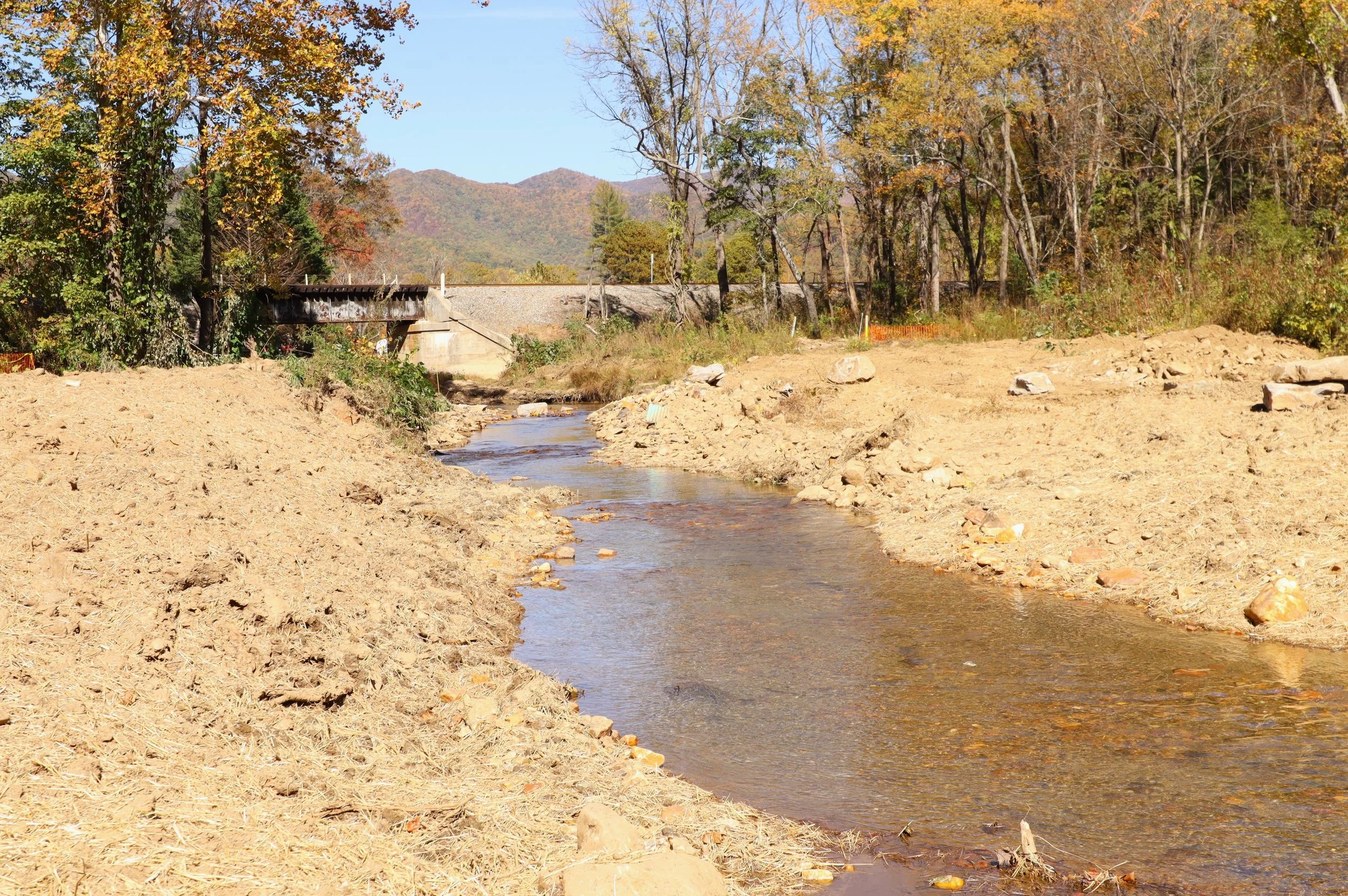
The second phase of construction of the Swannanoa River Floodbench Project focuses on a section of the waterway south of the railroad tracks behind the Riverwalk Park. Photo by Fred McCormick
The town awarded the project to North State Environmental, which partnered with Kimley-Horn and Associates and Jennings Environmental to lead the design and permitting phases, while PilotSE conducted surveys and mapping and Froehling & Robertson provided geotechnical engineering services.
The design was completed last July, with construction beginning in August. The final plans incorporated three properties on Center Avenue that were purchased by FEMA after Helene.
“In the original plans they were not involved in any way,” Goins said. “From a final design perspective, it worked out well because we have been able to use these properties as a staging area, instead of working around them. As a result, we were able to create a new green space, which should be better for stormwater management in the long-term.”
The three properties, currently owned by the county, allowed for expanded flood storage capacity in the final design.
The first phase of construction demonstrates a design that eliminates sharp angles in the course of the river, realigning the stream and benching the floodplain to allow gradual overflow in the event of heavy rain.
“Floodbenching is a term you hear used more and more, especially with grants that are starting to become available now,” Goins said. “Initially it’s very hard to conceptualize why we need to mess with the Swannanoa River and why we need to take down trees. I think as people see what transpires, and the beauty that comes out of it, in additional to what it does for the long-term health of our creeks and rivers, they will understand why this makes sense.”
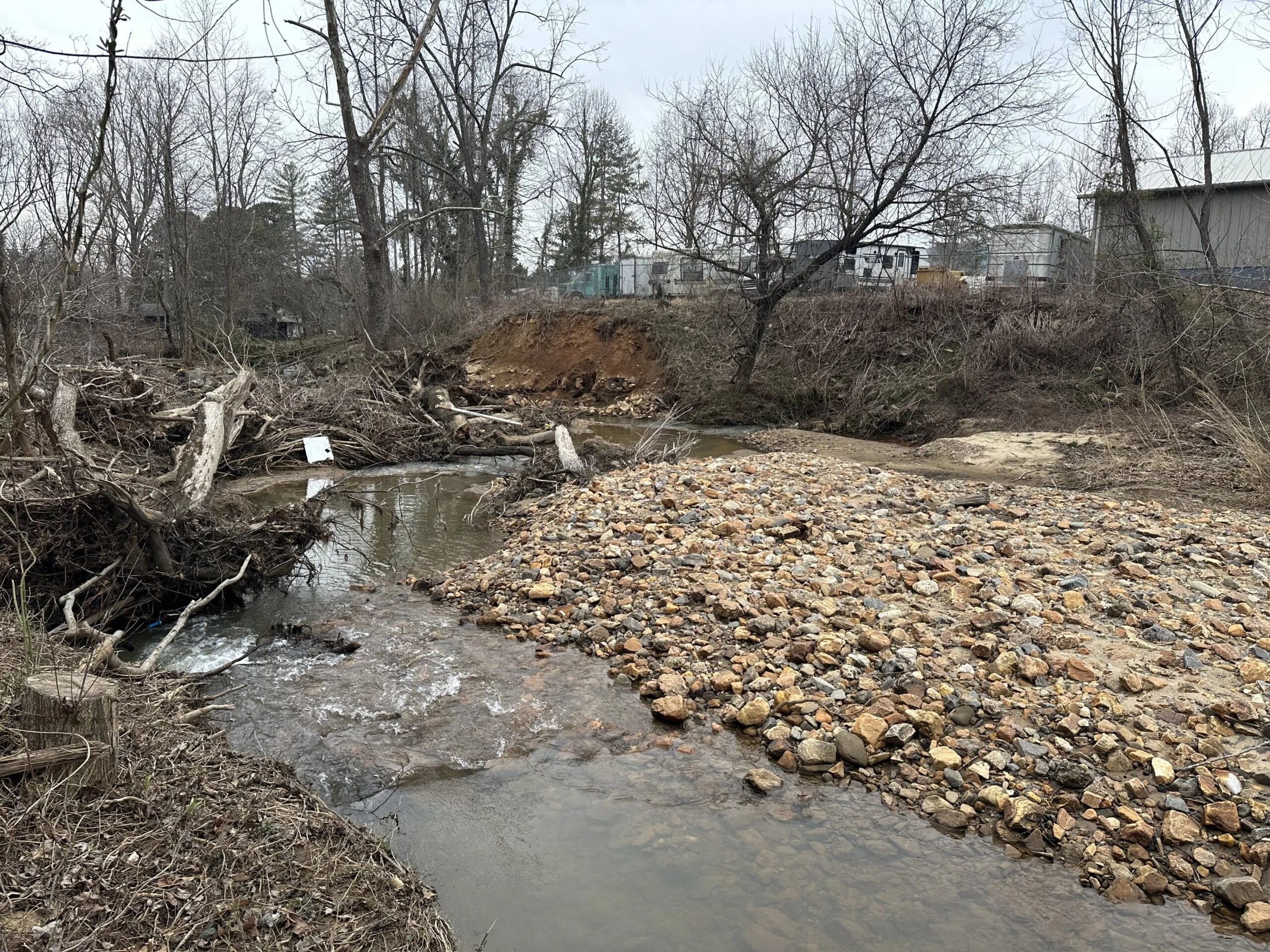
Debris, sediment and boulders fill a section of Flat Creek, following Helene in 2024. The area is include in the ongoing Swannanoa River Floodbench Project, which will reshape and stabilize more than a half-mile of the waterway. Photo courtesy of the Town of Black Mountain
The area near the confluence of Flat Creek and the Swannanoa River will resemble a public park when native vegetation is added, according to Goins.
“It has been amazing to see the progress every week,” he said. “We have been meeting with representatives from North State Environmental, Kimley-Horn and Jennings every Monday, and when you consider the scale of this project, their work has been impressive.”
With construction 50% complete, heavy equipment is now active on town-owned property behind a commercial property at 205 N.C. 9.
“This part of the project will also involve straightening out the river and creating a bench similar to what can be seen in the first phase,” Goins said. “One thing that will be different on this side is that there will be retention pond and wetlands, which will help catch overflow. Not only are we putting things in place to slow the river down, if it gets too high, we have an emergency fail-safe to catch excess water.”
In addition to flood mitigation, the project, upon completion, will reduce the potential for erosion, improve the riparian buffer and water quality and enhance the stability and function of the waterway. Work is anticipated to be completed by the end of the year, according to Goins.
“We are a little ahead of schedule, and for the purposes of this grant we are required to be finished with the construction by Dec. 31,” he said. “After that, we’ll do the planting once everything is finished. North State has done a phenomenal job, and the engineers have been on top of every little thing that pops up.”
The project, he added, will correct longstanding issues with the half-mile stretch of waterway, improving conditions downstream.
“Water has to have a place to go,” Goins said. “These rivers have been here for a very long time, and we’ve built around them, creating new ways for water to get into them. This is a way to help manage the excess water, so as it does rise, downstream, we’re helping prevent severe damage and flooding that can lead to people losing their businesses or homes.”