
Swannanoa Fire Department maintains strong protection rating
Chief Anthony Penland credits Hard Work and Community Support for N.C. Response Rating System Score
Fred McCormick
The Valley Echo
August 28, 2026
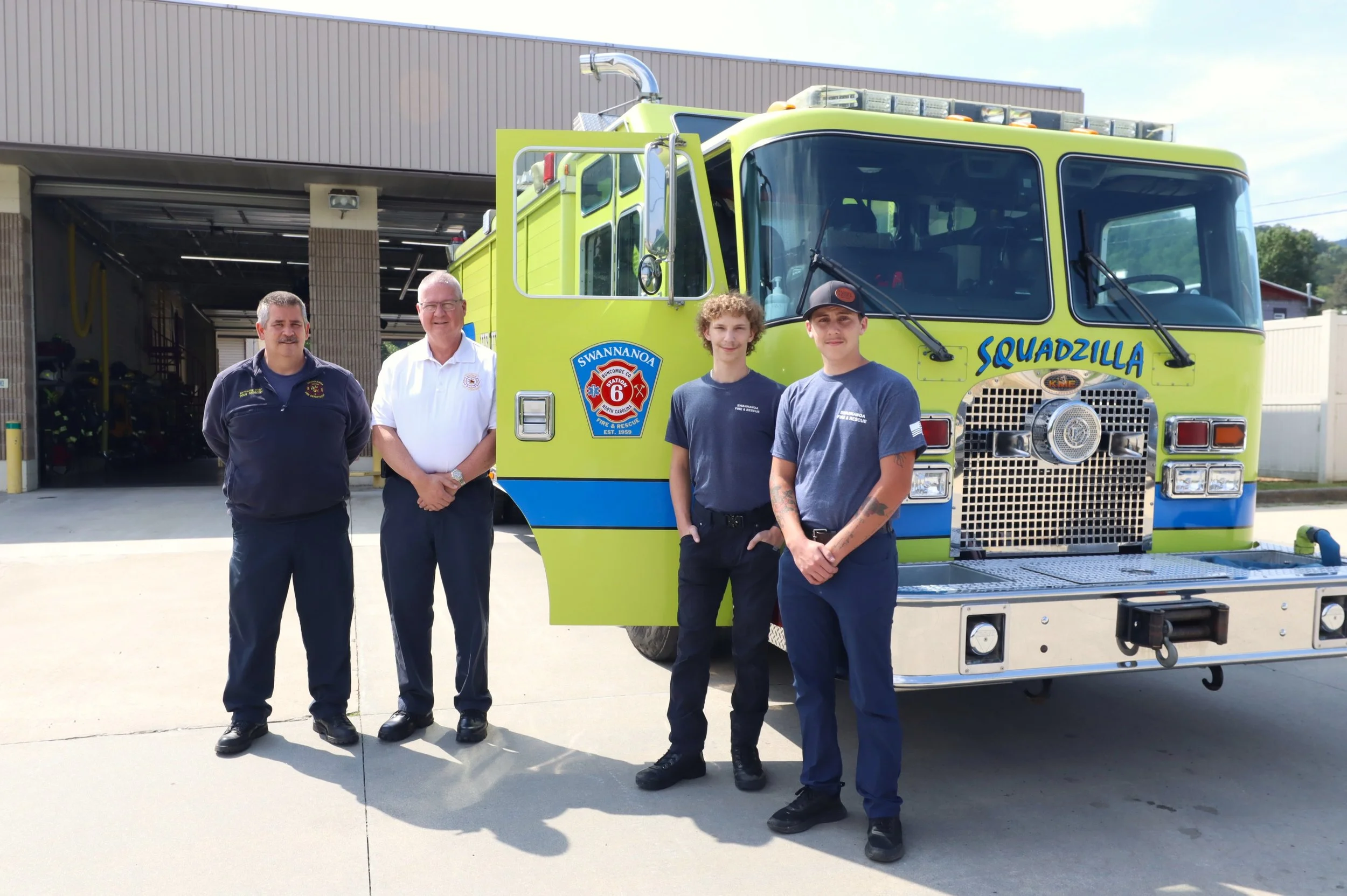
The Swannanoa Fire Department was congratulated, Aug. 25, by the state fire marshal, as the organization maintained an NCRRS Class 2/9E rating it first earned in 2021. Photo by Fred McCormick
The distinctive lime green apparatuses of the Swannanoa Fire Department are highly visible when parked in front of the main station on South Avenue, substation on Bee Tree Road or responding to emergencies. While they often serve as a tangible representation of the unincorporated community, within the department, the duties of 20 full-time firefighters, a team of part-time personnel and 10 volunteers focus on protecting the district they serve.
As Fire Marshal Brian Taylor announced, Aug. 25, the results of the department’s routine five-year inspection, he congratulated Chief Anthony Penland and his crew for their “commendable performance” in retaining a 2/9E rating with the N.C. Response Rating System.
"The residents of Swannanoa fire district(s) can take comfort in knowing this highly capable team of firefighters from the Swannanoa Volunteer Fire Department & Rescue Squad, Inc. is safeguarding them and their belongings in the event of an emergency," Taylor said in a press release announcing the results of the inspection.
The rating system, managed through the N.C. Office of the State Fire Marshal, inspects and assesses local fire departments throughout the state, scoring each based on its structural fire protection capability. The Public Protection Classification operates on a scale of 1 through 10, with the lowest number representing the best possible score. The split rating, which impacts insurance costs within the district, indicates two fire protection classes present within the service area.
The Class 2 rating places the Swannanoa Fire Department within the top 6% in the state, marking the second consecutive time the organization has earned the designation. Penland, in his 25th year as chief of the station he joined in 1990, said the department was “honored” to maintain the designation.
“Especially coming out of the storm, because there were around six months we were out of our Bee Tree station because of storm damage,” he said. “Part of the rating is response, and our response to structure fires in our community requires two engines and a ladder truck or a service truck. If it’s in an area without a hydrant it requires a tanker. Our Bee Tree station typically holds one engine and a tanker, while our main station holds the other engine and a ladder (truck), so we were scattered.”
The department carried a Class 5/9 rating when Penland became the chief, prior to the addition of a substation.
“When the Bee Tree station came online we added more personnel and training grounds,” he said. “That gave us an opportunity to earn more points on our inspections.”
By 2021, the Swannanoa Fire Department was positioned to attain its highest rating.
“We wanted to see what we could do to max out, and when I say that, we require all of our full-time staff to take 240 hours of training, which requires a certain amount of hours for each section of the state fire marshal’s training criteria,” Penland said. “When it came back that year that we earned enough points to be rated a 2, I looked at doing the exact same things for the next five years to maintain that. We added one staff member, which helped us increase that score a little.”
The 9E classification reflects the challenges of providing fire protection in a rural community, according to the chief.
“Buncombe County recognizes a six-mile district. Truly, five miles from a fire station, and within 1,000 feet of a fire hydrant, is what you’re supposed to be,” Penland said. “But, in rural Western N.C., there are just some places you’re going to be outside of five miles and nowhere near a fire hydrant. So, anybody outside of five miles, but within six, pays a Class 9 insurance rate. Outside of six miles is a Class 10, which is defined as unprotected.”
A native of Swannanoa, Penland’s tenure as chief has coincided with two of the worst disasters in the history of the community. A fire at the shuddered Beacon Manufacturing plant in 2003, feet away from the station, remains one of the largest structure fires in the state’s history, while Helene, in 2024, caused unprecedented flooding and claimed the lives of 43 people in Buncombe County.
While those incidents tested the limits of the local fire department, they reaffirmed the staff’s commitment to training and preparedness.
“The hard work of our firefighters and staff, who come in here ready to work everyday, is the reason we have been able to keep improving the level of service we provide to this community,” Penland said. “I love putting my uniform on, and the staff here feels the same way. The support we receive from our governing body provides us with the equipment we need to fulfill our duties, but the support from our community is tremendous. That’s why we’re here.”
The results of the OSFM inspection, he added, demonstrate the department’s priorities.
“We want the community to know we’re doing the job that is needed to make Swannanoa a safe place to live and work,” Penland said. “When people or businesses are considering moving into your community, they look at the fire service rating. I’ve always tried to leave things better than I found them, but the credit goes to the hard work of the men and women in this department. Being a part of that is an honor.”