
Rebuilding Black Mountain: Public Works and Sanitation
Department adapts to displacement and suboptimal facilities while delivering essential services
Fred McCormick
The Valley Echo
July 14, 2026
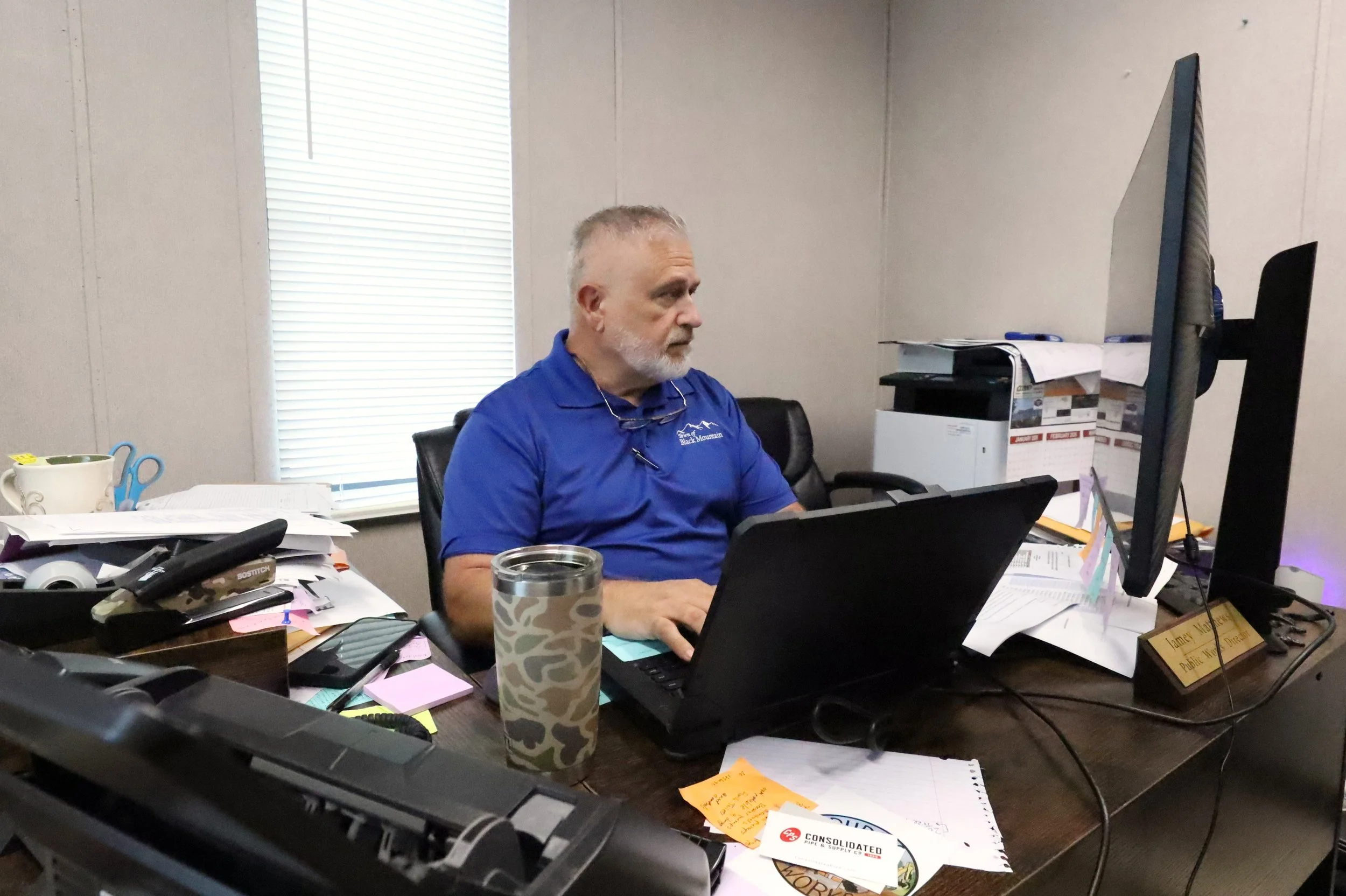
Black Mountain Public Works Director Jamey Matthews works, July 13, in a temporary office at 304 Black Mountain Avenue. The department of 28 employees was partially displaced when flooding from Helene damaged much of the building that housed public works since 2018. Photo by Fred McCormick
The water from the adjacent Swannanoa River began rising in the Town of Black Mountain Public Works and Recreation and Parks building at 304 Black Mountain Avenue on the morning of Sept. 27, 2024, as crews stationed nearby scrambled to move vehicles from the nearly 4-acre property to higher ground.
The scale and likely impact of the damage to the 22,000-square-foot structure, purchased by the municipality for $2 million in 2018, was immediately apparent.
“The entire building, and everything in it, was under about a foot of mud by the time we got in it,” said the town’s public works director Jamey Matthews, approaching his 15th year in the position. “All the electric outlets had been submerged, and everything inside was covered in silt. You just knew it was going to be bad.”
Nearly two years later, the department staffed by 27 employees, responsible for maintenance of the town’s major infrastructure, including roads, sidewalks, parks, sanitation and the water system, continues to weather the challenges of displacement and a partially functional logistical headquarters.
The days after Helene were hectic for public works personnel, as crews worked tirelessly to clear roadways of fallen trees, assist first responders blocked by debris and restore the municipality’s water system to basic working order. They did so without many of the essential tools, equipment and vehicles that were readily available before the natural disaster.
“The offices in the building, which were used by our department, recreation and were in the process of being set up for the planning department, were destroyed. Computer keyboards, desk, anything you can imagine, were covered by water, which got up to over 3 feet throughout most of the building, 4 in some spots,” Matthews said. “In the shop, anything that had bearings, used grease or hydraulics, anything like that, was done.”
Vehicles, which employees were scrambling to move to higher ground on the morning of the storm, according to the department head, were also severely damaged.
“We had our guys staying in the hotel across the river, waiting on the storm, because we wanted everyone here,” Matthews said. “I ended up getting them from the hotel, because the water was getting close to that door. We came straight over here that night, but the water came up so fast, they couldn’t get some of it out of the parking lot.”
A pickup truck fitted with a hopper, utilized for sanitation routes containing narrow roadways, stalled in the floodwater, he added.
“One of our employees was driving it around the building, and before he got it out, water was over the front bumper,” he continued. “He had to climb on top of the cab, and was fortunately rescued, but it was chaos after that.”
One of the town’s three rear-loading sanitation trucks at the time was out for repairs, while the two remaining vehicles, and a pair of scout trucks, equipped with hoppers, were destroyed. Public works vehicles ruined by the flood included a bucket truck, which was previously out of service, according to Matthews, and another decommissioned vehicle.
“In public works, we only lost two pickup trucks that we were using,” Matthews said. “Our biggest loss in that department, besides the building itself, was equipment, like mowers, hand tools, tractors and things like that.”
Nowhere else to go
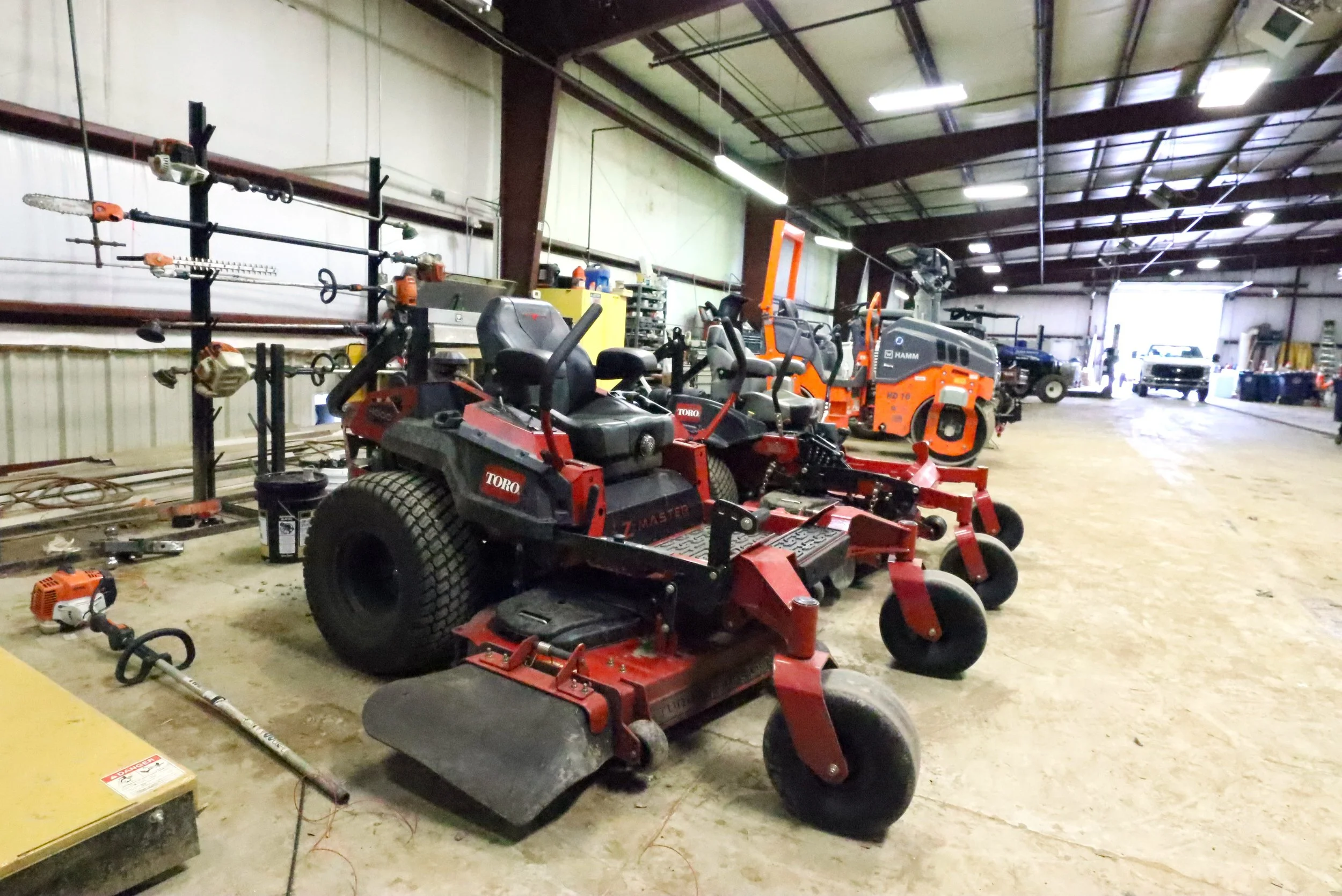
Black Mountain Public Works crews continue to operate in a large shop at 304 Black Mountain Avenue, while administrative staff occupy mobile office units on the property. The building, which also houses the town’s recreation and parks and planning departments, was flooded during Helene. Photo by Fred McCormick
Public works and sanitation administrative employees occupied a makeshift work space in the training room at the public safety building for eight months, following Helene, until temporary offices were delivered in May of 2025. The department is one of five within the Town of Black Mountain that remains fully or partially displaced since the natural disaster.
The mobile offices situated on the east side of the Black Mountain Avenue property, which house the planning and public works departments, were initially provided by the Army Corps of Engineers, according to town budget analyst Matt Begley, who includes the facilities among the 41 ongoing capital projects in the municipality.
Leased for $17,000 per month, the contract for the mobile units was transferred to the town, which is reimbursed for the expense by FEMA. Classified through the FEMA Public Assistance program as a Category B project, the temporary facilities are anticipated to remain in place until the public works and planning departments building is repaired.
The town filed an extension request for the mobile units in May, according to Begley.
“There were some concerns when the Army Corps of Engineers transferred the lease to the town, related to insurance coverage and FEMA assistance,” he said. “Insurance paid for a few months, but FEMA assumed the reimbursements after that.”
The temporary public works office space has provided stability, according to the department director, but limited space for the seven staff who occupy the unit.
“I’m very thankful we have these, but they do come with plenty of challenges,” Matthews said. “We’re fighting mold and insect issues right now. When we have department meetings, we don’t even have enough chairs for the small break room, and we’re sharing offices.”
Reminders of the natural disaster are visible all around the property, where a crumpled fence lines the western edge, while shipping containers hold tools and supplies that were recovered after the storm. Inside the large shop, which employees restored to functional condition in the months after the disaster, crews perform maintenance on equipment and vehicles in a work area without working air conditioning or heat. The garage is the only operational space inside the structure, where previously flooded walls in the unoccupied offices have been removed, exposing the studs to which they were once affixed.
“The shop is fully functional, and being used as it was before Helene,” Matthews said. “We use it to store and repair equipment, work on vehicles and other projects. But, it’s a big difference, as far as working on the really hot days with no air.”
Industrial fans circulate the humid atmosphere in the metal building, while crews seek relief and eat lunch around tables in the break room of the nearby temporary office building.
“We do have lights and water on at the shop, but the HVAC systems were underwater during the storm and destroyed,” Matthews said. “We have propane heaters for the winter, but I’m not sure if people realize how hard these guys are working in some pretty tough conditions.”
While the building was among the hardest hit town assets in the natural disaster, an estimate of the total cost or timeline for repair have yet to be determined, according to the budget analyst. FEMA Public Assistance initially obligated approximately $81,000 in funding for the project. The town received an additional $1.5 million of insurance proceeds for the structure.
“We involved engineers because we knew the damages were going to be far more than the funding they obligated,” Begley said. “It’s one of those things where FEMA comes in, does their scoping to figure out what the damages are, and misses some stuff, every now and then.”
A recently completed assessment by Domokur and Associates, a Brevard-based architectural, design and planning firm, has been submitted to the town, Begley added. The report is under review by the town’s insurance provider, before FEMA updates its determination of eligible repairs.
“Originally, there was a different firm assessing the building, but eventually, for performance reasons, we decided to give that project to (Domokur),” the budget analyst said. “That’s part of the reason it has taken some time.”
While the process has been lengthy, he continued, the project is “on the right track.”
“The estimated damages are well over the amount of obligated funding, but that total is still nebulous as it goes through the process with FEMA,” Begley said. “Based on what the engineers have said, I don’t believe we will have to move the building, or anything like that, which was one of our initial concerns.”
An estimated timeline for completion remains unclear, with an optimistic approximation settling sometime around next summer.
“FEMA had us submit a timeframe to them, and it was a very ambitious one, but I think we’re still mostly on track,” Begley said.
Matthews credits employees in the department for their willingness and ability to adapt to a challenging situation.
“We don’t have anywhere else to go. Everyone in the town, with the exception of people who work inside of town hall, are displaced,” he said. “Until we get back in our building, we’re just going to have to make it work. I’m really proud of the job this department has done, especially considering how challenging this has been.”
Vehicles and equipment
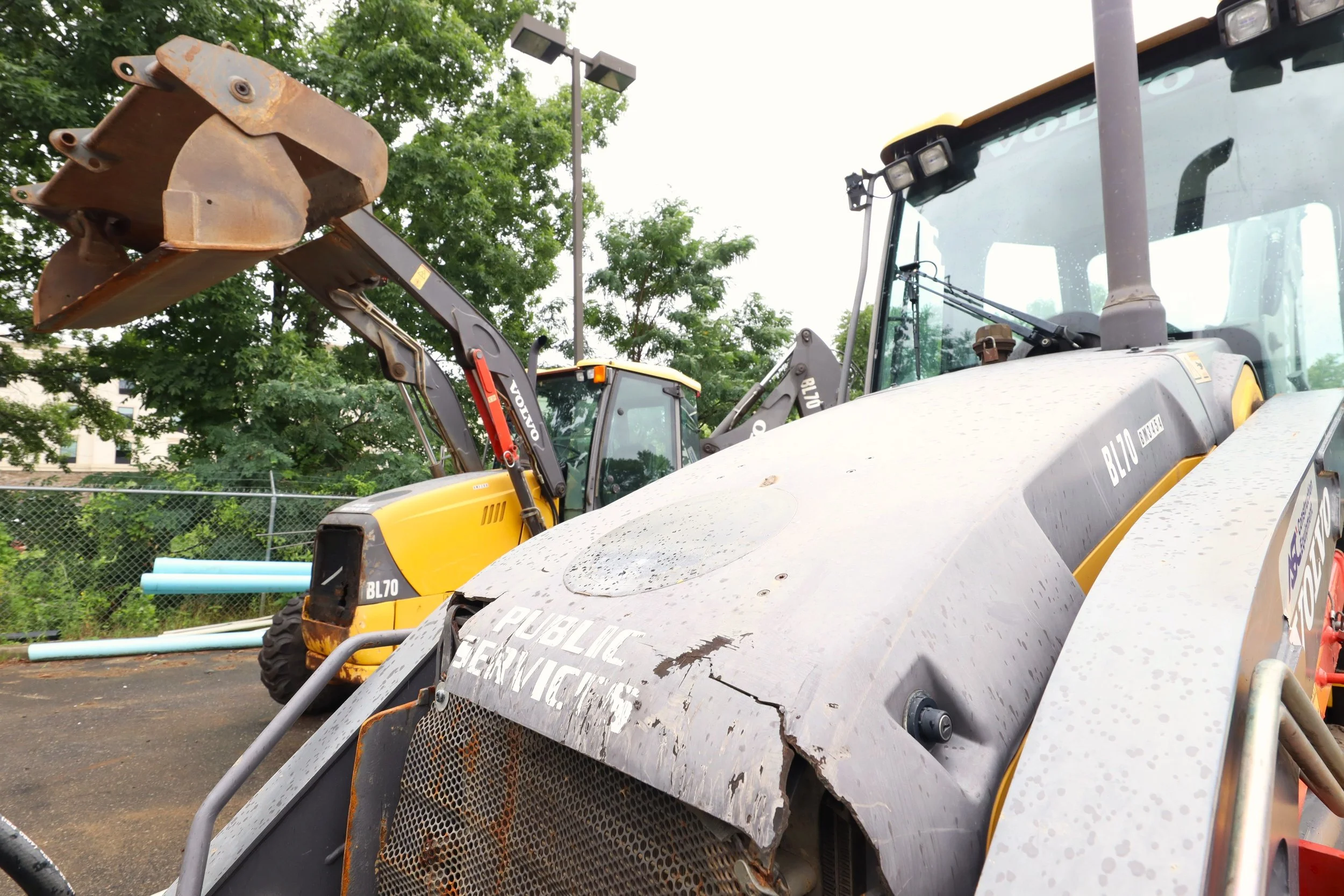
Equipment and vehicles were among the Black Mountain Public Works assets damaged or destroyed by Helene in 2024. The town has tapped multiple funding sources to replace sanitation trucks and other equipment since the natural disaster. Photo by Fred McCormick
Public works is responsible for maintenance, preservation and expansion of the town’s infrastructure system, which includes 43 miles of public streets, approximately 10 miles of sidewalks, parks and greenways. Of the 27 employees within the department, 18 are assigned to divisions associated with those duties.
The sanitation division, which operates under public works and is supervised by Rechelle Vilevac, consists of nine employees.
Equipment and vehicles used by nearly all of them were damaged or destroyed by flooding during Helene.
A decommissioned bucket truck and another vehicle that was to be sold at auction were among the losses, according to Matthews, while two pickup trucks, one of which was used by the recreation and parks department, were destroyed. Equipment, including tractors, small hand tools and attachments were submerged by the muddy river water.
Much of that equipment has been replaced through insurance proceeds, according to Begley, but the funding methods were complicated by a variety of factors.
“For vehicles, the thing that is a bit of a wrinkle is, for example, we can’t go out and purchase a 1992 dump truck,” he said. “We received about $750,000 from our insurance company, and that immediately went towards critical needs. That funding covered all of the vehicles, but it took all of it to replace just those critical vehicles. There was a big gap between what insurance paid and the cost of replacement.”
The town was awarded a grant through the USDA Disaster Assistance Fund for approximately $556,000 to purchase additional vehicles.
“We were able to cover the costs of a small garbage truck, two standard size garbage trucks and a knuckle boom truck, as well a police vehicle that was totaled in a landslide,” Begley said. “The USDA fund replaced a lot of the public works fleet, while the insurance covered other vehicles.”
Unrelated to Helene recovery, the town was awarded a grant of $525,000, through N.C. Department of Environmental Quality, for the purchase of two recycling trucks.
“That grant is separate from the disaster-related projects, but holistically, it helps the fleet,” Begley said.
The department will receive two sanitation trucks in the coming months, according to Matthews.
“Sanitation is fully staffed and operating on a normal schedule,” he said. “We’re glad we’ll be receiving two new trucks, which should help us increase our capacity. That’s important because we’re on time constraints, and we have to be inside the gates at the dump by a certain time everyday.”
That division, he added, is currently focused on keeping pace with growing demands.
“We’re at a point with sanitation where we’re no longer fighting through recovery and can plan for the future,” Matthews said. “The rest of public works is a different story.”
No rest for the weary
Town of Black Mountain Public Works and Sanitation employees continue to adapt, nearly two years after Helene, as crews work in a shop without heat or air, while administrative personnel are stationed in a mobile office unit. Photo by Fred McCormick
Many of the duties charged to public works employees are physically demanding and often urgent. While the department provides vital services in any municipality, the work often “flies under the radar,” according to Matthews.
“A lot of times it can be hard for our staff, because they’re out doing tough jobs in the heat or cold, but this is a department that doesn’t get the kind of public recognition first responders do,” the director said. “Don’t get me wrong, police and fire deserve the praise, but I think it can be easy to forget about the people standing in knee-deep water fixing a line or welding in a hot shop in the middle of July.”
Several of the staff were assigned to fire engines in the aftermath of Helene, clearing blocked roadways to allow entry for emergency services. Since then, administrative work has “doubled, if not tripled,” according to Matthews.
“I get a lot of phone calls and emails everyday with issues, where I go to sites to meet with the public, plus I’m supervising 20-something staff,” he said. “So, there are my normal duties, then all of these other projects, some related to recovery and others that aren’t.”
The town’s water system operates as its own division within the town structure, however, public works oversees maintenance and repairs. Following a recent determination by FEMA, which allows the town department to proceed with repairs for road projects that do not require engineered plans, crews are preparing to continue rebuilding infrastructure damaged by Helene.
Listed as Town Roads 1 and 2 on the list of ongoing capital projects within Black Mountain, approximately 17 repairs are included in the groups.
“Most of those our department can do,” Matthews said. “There are roads that haven’t been repaired yet, and that’s not because we didn’t want to do them, it’s because we hadn’t been released to do them. We’re getting really close, but there is a process we have to go through.”
Other than pending road and future water system repairs, the department has completed all of the projects related to Helene, he added, while operating at nearly full capacity in a complex and unsettled landscape.
“Some of our biggest achievements have been related to restoring operations,” Matthews said. “We have our shop back, we got our lifts working, so we can still do maintenance on our vehicles and we’re better equipped to prioritize projects. Every time we get vital equipment we need to the jobs, morale gets a little bit better.”
The adjustment for public works and sanitation staff has required flexibility and commitment and patience, according to the department head.
“Engineering and funding takes time, and that’s something we all understand around here,” Matthews said. “We know our town, and other government organizations, are working on getting us back in the building. We just have to keep pushing ahead and work with what we have.”