
Rebuilding Black Mountain: Enduring challenges complicate town's Helene recovery efforts
Numerous projects, limited cashflow and capacity constraints Exacerbate Complex Process, nearly two years Later
Fred McCormick
The Valley Echo
June 29, 2026
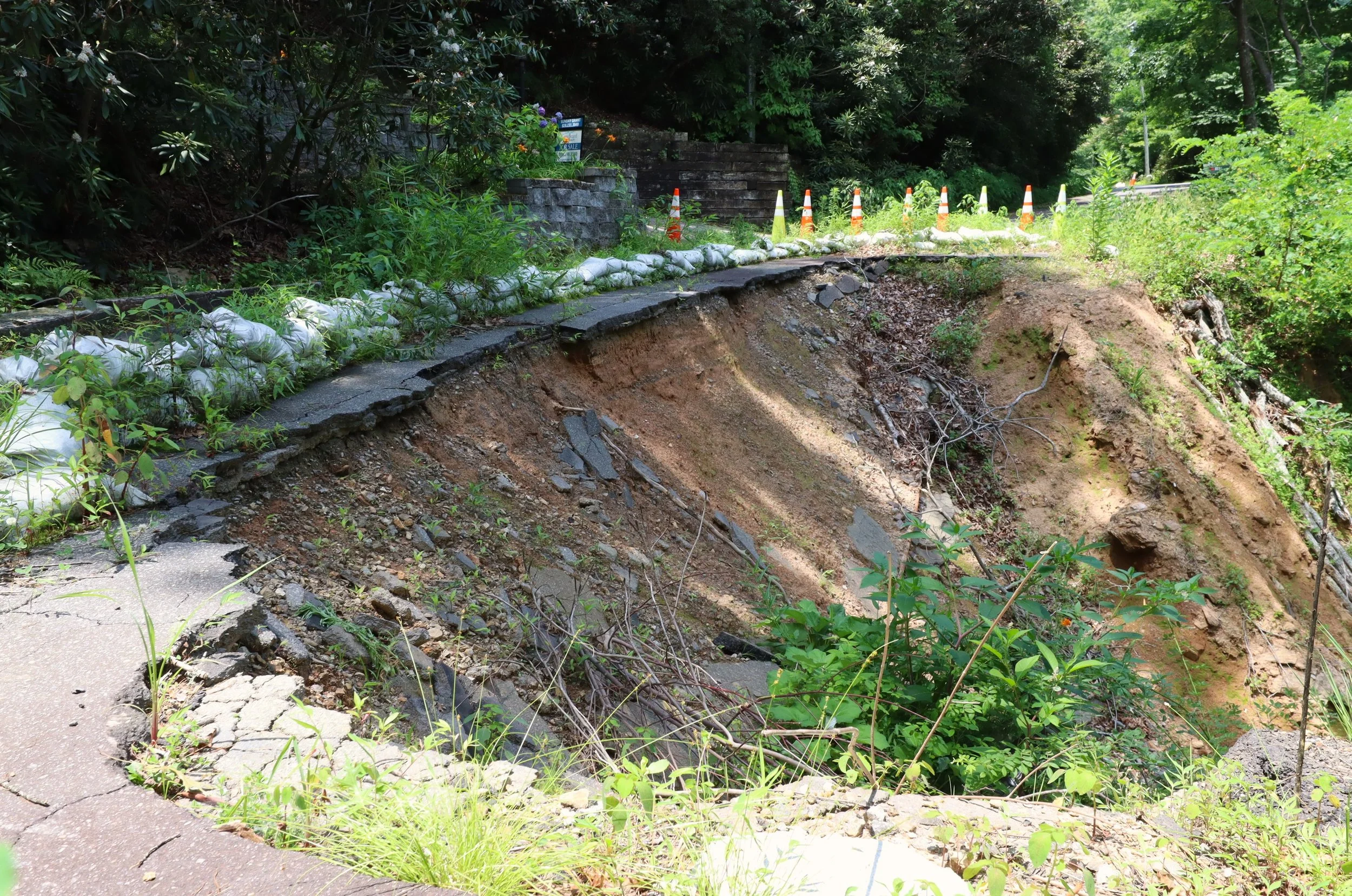
A nearly 143-foot section of Hilltop Road in Black Mountain was washed away during Helene. Construction of the project, which is in the process of final approval through the FEMA Public Assistance program, is expected to begin in the coming weeks. Photo by Fred McCormick
This piece is the first in a series examining the status of the ongoing Helene recovery process within the Town of Black Mountain, nearly two years after the natural disaster damaged or destroyed critical infrastructure.
The residents of the Town of Black Mountain who were able to fall asleep on the evening of Sept 26, 2024, likely did so with a growing sense of anxiety, as a massive and powerful tropical storm churned toward Western N.C. The light of dawn revealed destruction that few could have imagined.
Twenty-one months after Helene left widespread damage in its wake, the lingering impacts of the natural disaster remain conspicuous and consequential within the municipality, where the road to recovery has navigated a lengthy and complex process. As the cash-strapped town prepares to enter a new fiscal year with vacancies in key positions and the elimination of other administrative roles, rebuilding Black Mountain will require officials to contend with dozens of capital projects, within a shifting landscape of funding considerations and grant programs.
Matt Begley was nearing the completion of the courses required to earn his master’s degree in public administration from the UNC School of Government when Helene devastated his native town. The son of a former Black Mountain mayor and grandson of a former longtime alderman volunteered any assistance he could provide in the immediate aftermath of the storm.
“I did a little bit of downtown business outreach work during that time,” said Begley, who was hired last October as a budget analyst, after receiving his degree. “I really felt like I needed to be back in WNC, after Helene. That wasn’t necessarily my plan before that, but seeing the community so devasted, it didn’t feel right putting my energy anywhere else.”
As he began his new role, following the departure of the town’s finance director and project and facilities manager last fall, the title and job description were “a little bit aspirational.”
“It was written to be under the finance director, mainly trying to figure out how to cashflow all these projects and do it in a way that didn’t slow the progress, but because there wasn’t a finance director, I worked with the assistant town manager to run the informal recovery office,” Begley said. “With the project manager accepting a position with another town, it very quickly turned into a lot of coordinating with engineers, to support the assistant town manager, knowing it was far more work than one person could do.”
More staff turnover followed, as the previous town manager announced his resignation last December, followed by the departure of the assistant town manager in March. Facing a significant financial shortfall, the town council eliminated the unoccupied assistant manager and project manager positions in the proposed 2026-27 budget, which is expected to adopted in a special call meeting at 8:30 a.m., Tuesday, June 30. A search to permanently fill the town manager position, occupied in the interim by Richard Hicks since January, remains ongoing, while the town’s finance director office is still vacant.
Those personnel changes brought a new task to Begley’s desk, when elected officials asked him to create a spreadsheet tracking ongoing capital projects and grants. The report, which he presented, May 11, offered a comprehensive analysis of the town’s recovery progress.
“We hadn’t given an overall update for the projects in a little bit of time, as I tried to catch myself up on the things I hadn’t been directly involved in,” Begley said. “The main things they wanted to see was the current status of the projects, how we’re ensuring things don’t fall through the cracks and a measure of level-setting on the current environment, along with a reasonable expectation for progress, going forward.”
The analysis identified 41 capital projects within the town, compared to 31 in Buncombe County, 25 in the City of Asheville and 24 in Wake County. Some items represented on the spreadsheet, including the building that once housed the public works and recreation and parks departments, have remained unoccupied since Helene, while infrastructure like the pedestrian bridge that once connected The Oaks greenway trail to Veterans Park has yet to be repaired.
Complications on all fronts
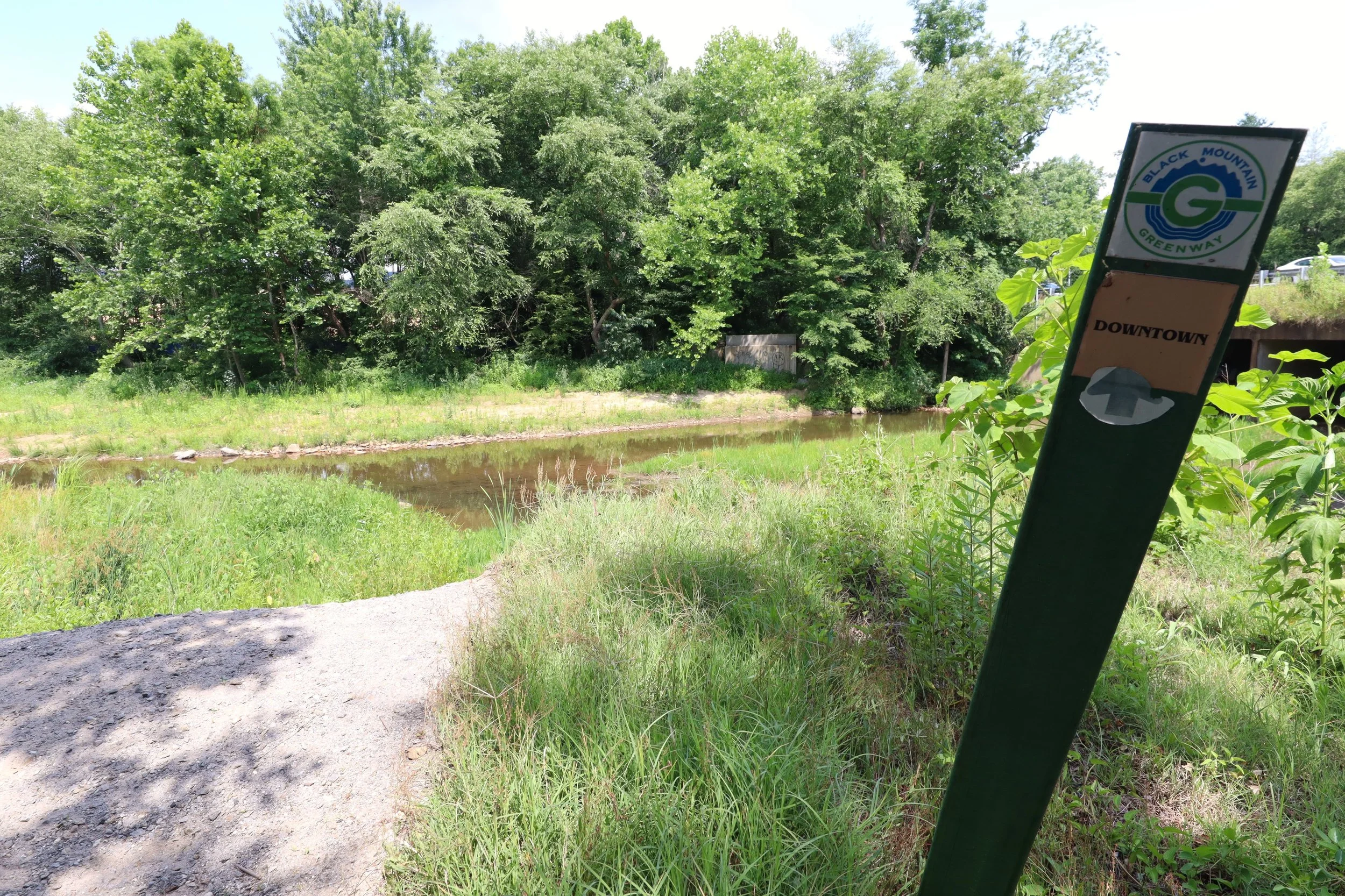
An 80-foot bridge that once connected the east and west banks of the Swannanoa River, in Veterans Park, will require a structure spanning nearly 135 feet to span the eroded waterway. Photo by Fred McCormick
At first glance, the task of replacing an approximately 80-foot bridge allowing bicyclists, walkers and runners to traverse the Swannanoa River, as it winds through Veterans Park, appeared to be a straightforward one. The structure itself survived the storm, knocked free of its anchoring systems on the east and west side of the river. The project was one of around 30 in Black Mountain that qualified for the FEMA Public Assistance program, which supplements local governments with federal grants in the aftermath of a presidentially declared disaster. That source of funding, according to Begley, remains the most adequate for the town.
In practice, however, replacing the once-popular piece of Black Mountain Recreation and Parks Department infrastructure has required multiple phases. The site was assessed by FEMA officials shortly after the storm, with an initial estimated cost of repair around $800,000, qualifying as a “small project.”
“For projects under $1 million, those are considered small projects and FEMA will give you that funding up front,” said Begley, who added the initial estimate for the project called for replacing the 80-foot bridge. The severe erosion caused by Helene, along both sides of the Swannanoa River, however, requires a 130-135-foot structure to span the gap. “Increasing the length of the bridge put that project over $1 million.”
Functionally, that process operates under a true reimbursement structure, he continued.
“You pay for part of it and send them the amount you have paid already. They reimburse you for that and it just keeps repeating that cycle until the project is finished,” Begley said. “The bridge shifted into that process, and with the higher dollar amount there are also more requirements for reporting. FEMA is much more stringent in its oversight of those types of projects.”
While FEMA has now approved around $1.3 million to replace the Veterans Park bridge, that funding allows the town to include additional mitigation measures. Currently, engineering firm Kimley-Horn is developing a hazard mitigation plan for the project, which, once completed, will be submitted to FEMA.
Even vital repairs that fall under the $1 million reimbursement threshold do not necessarily result in a quick fix. When heavy rain from Helene washed out a nearly 143-foot section of Hilltop Road, near the Black Mountain Golf Course, the estimated combined cost of engineering and construction was around $661,000. Under the FEMA Public Assistance program, the project is now in the approval process for the full amount.
“We just had a meeting with FEMA about that project yesterday, and they looked at what the engineers said needs to happen with Hilltop Road,” Begley said. “They basically gave us the go-ahead, saying, ‘yes, we will fund that more than the $58,000 we have given you so far.’”
Other capital projects, like the golf course maintenance building, have required the town to seek funding from alternative sources, including the N.C. Helene Local Government Capital Grant Program and the Buncombe Tourism Development Authority LIFT Fund.
“For that one, FEMA came back to us and said they would give us $21,000 for that building, but obviously that won’t work,” Begley said. “We had to look for other funding to cover that gap.”
The total cost estimate for engineering and constructing a new maintenance building is around $1.9 million.
Meeting varying standards associated with various grant sources requires diligent oversight from staff, but external funding opportunities are widely available, according to Begley.
“Right now is a good time for grant funding because there are so many Helene-specific grant programs out there, for the counties in the disaster declaration area,” he said. “The amount of resources being directed at this area right now, from the federal and state governments, is fairly high, because the cost of restoring infrastructure is high.”
Capacity limitations of a small town
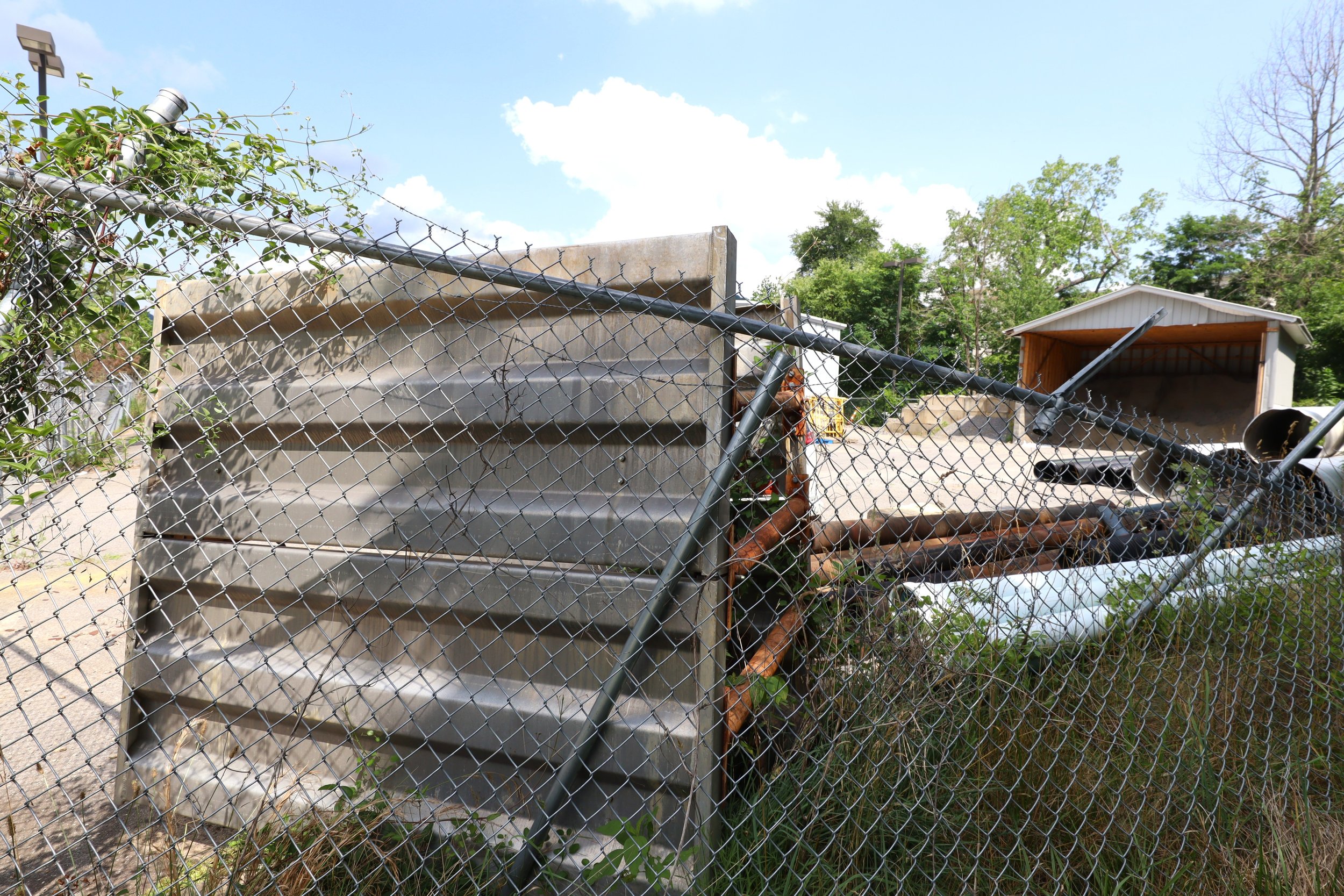
Multiple facilities within the Town of Black Mountain, including the building that once housed the public works and recreation and parks departments, remain unoccupied nearly two years after Helene. Photo by Fred McCormick
Managing multiple streams of funding in a small municipality recovering from a natural disaster requires diligent oversight and work beyond the scope of the normal daily duties of a finance director, according to Begley.
“There is a lot of money involved in recovery projects, and doing a revolving fund of cashflow loans and other funding sources are not within the typical structure of municipal financing,” he said. “Of course, that is a thing that can happen, but in a small town like Black Mountain, there isn’t always internal experience with that process.”
With the office of the town’s chief finance officer vacant for nearly 10 months, the municipality is currently receiving support from the N.C. League of Municipalities.
“Without having that internal senior level experience, it slows down the process because we have to go to other state resources for that background experience,” Begley said. “Another key piece is making sure the financial system itself is structured in a way that can handle all of these projects. Just taking a guess, I doubt the town has ever had this many projects going on at one time.”
Overseeing the tasks associated with proper reporting for potential grant sources often become the responsibility of town staff, he added.
“The staff is able to do these things, but a lot of them are outside of the scope of their current positions,” Begley said. “So, they still have to do the normal work associated with their jobs, on top of reaching out to external resources to cover the gaps. That’s something a finance director would be doing.”
Managing multiple aspects of more than three dozen capital projects is another significant role in the overall recovery process. The town tapped Chad Goins to serve as its interim project manager early this year, but the project and facilities manager position is set to be eliminated in the upcoming fiscal year.
Six employees of the Land of Sky Regional Council are assisting the Town of Black Mountain with the management of ongoing capital projects.
“They are helping us a lot, with communicating with FEMA and, to an extent, communicating with engineers to make sure things are running smoothly,” Begley said. “The interim project manager has been communicating with construction firms and engineers, especially regarding the projects that were already underway prior to Helene.”
A typical caseload for a project manager, according to the analyst, is between three to six.
“There are a lot of ways, with extra project managers, we could be a lot more proactive, if we had the time to do that,” Begley said. “For me, personally, not being a general contractor, there are plenty of times I have to go through an external resource to get an answer for a question that someone with more project management experience might have readily available.”
The support from Land of Sky, a multi-county, local government, planning and development organization that works within Buncombe, Henderson, Madison and Transylvania Counties, has been “incredibly helpful” in the recovery process, he added.
“We originally reached out to them for help managing the vast quantity of projects we have,” Begley said. “Gradually, they introduced another person and started helping with grant applications, as well.”
One unique aspect of the town’s recovery process, according to the analyst, is its success in identifying and locating grant funding for nearly all of the capital projects. Land of Sky employees have provided additional support in managing and reporting for those funding sources.
The loss of institutional knowledge associated with the overall recovery process and projects that predated Helene creates another challenge for the remaining staff, according to Begley.
“There is a gap there with some of the projects that were pre-Helene, like the Riverwalk Greenway project that has gone through four or five people,” he said. “There is a lot of institutional knowledge that has been lost there, so we’re piecing together records from the decade-plus history of that project.”
‘I never imagined it would take this long’
Less than a year ago, Begley was eager to return to his hometown and assist with the growing number of looming recovery projects.
“For a few days, I really thought I should drop out and go back home,” he said. “Several of my professors said, ‘no, you will be much more helpful in years two through 10 of recovery.’ At the time, 10 years seemed like a lot, but I got the general point that this would take a while.”
The task of compiling a comprehensive overview of ongoing capital projects and potential funding sources offered additional insight into the complexity of the overall recovery process.
“There is a whole lot more going on behind the scenes than I realized, from structuring the programs, how the processes work for distributing the funds or how some grant programs interact with other programs,” Begley said. “There is a whole lot of work and a whole lot of people doing unglamorous but very necessary work to make those programs function and these projects happen.”
Internally, capital projects related to Helene recovery impact nearly every department in the town, he added.
“We also have to follow our own ordinances and codes, so we interact with the planning department, figuring out permitting required for all these projects, floodplain ordinances and federal standards,” Begley said. “We also have to coordinate with public works and see what work they might be able to cover. But, there is a lot of support, within town staff, for completing these projects in a way that will provide the town and its residents a net benefit.”
Nearly two years after Helene, multiple town facilities remain unoccupied or unusable, while the projects associated with each are either active, on hold or designated to commence in the future. The damaged infrastructure serves as a visual reminder of the devastation caused by the unprecedented natural disaster.
“I never imagined it would take this long,” Begley said. “A lot of these funding programs are built a certain way because they have to serve multiple purposes. With FEMA, they’re serving a lot of different purposes, and one of those is to be a steward of federal funds and make sure they are operating in the best interest of the entire country. There are a lot of elements of that program that are built around making sure those funds are safeguarded and used properly. That comes with a lot of documentation, a lot of evidence gathering and a lot of back-and-forth on making sure that specific damages are, in fact, related to Helene.”
The meticulous reporting required for each project results in a lengthy process.
“I also share those frustrations, and there are times some of the work seems superfluous,” Begley said. “But, it usually goes back to making sure that when a disaster happens, the tax dollars of residents of the U.S. are being used responsibly.”