
Oak and Grist: ‘We’re trying to figure out how to comply’ with town ruling
Business owner asserts he received no prior indication of compliance concerns
Fred McCormick
The Valley Echo
July 23, 2026

William Goldberg, owner of Oak and Grist Distilling Co., has adapted his business to comply with a July 14 ruling by Town of Black Mountain officials. Tasting room services have been moved outdoors, as Oak and Grist continues to serve customers. Photo by Fred McCormick
Annual fire inspections have been a regular occurrence at Oak and Grist Distilling Co. since the business opened its doors to the public in 2017.
“Oak and Grist has been operating in the same location for the last 10 years,” said cofounder and head distiller William Goldberg. “For the last 10 years, annually, an inspector walks in our building and looks at everything going on.”
It was a process that never caused concern until June of this year, following a routine inspection by the Town of Black Mountain. Eight weeks later, Goldberg was directed to relocate the whiskey barrels in the building and prohibit the public from entering.
“What it calls into question for me, as a whiskey maker and business owner, is why did it take nine years for town officials to tell us we are out of compliance?” he said. “I am not a code enforcement official, but an inspector walks through this building every year and it took nine years for one to say we were doing something wrong.”
The operator of Oak and Grist was informed, July 14, of the ruling by town officials. The business, which operates in a heavy industrial zoning district on the western edge of town limits, is actively exploring options to remove the whiskey. The distillery has modified its tasting room operation to serve customers outside.
The decision by town code enforcement officials followed an annual fire inspection, June 1, when a report noted approximately 4,000 gallons of distilled spirits on the property. While the fire inspector noted a 2018 N.C. State Fire Prevention Code exemption for storage in wooden barrels, he indicated concerns with the quantity of Class II combustible liquids stored in the building, according to a summary from the town’s planning director, who added “other issues” were identified with the fire alarm and sprinkler system.
The four-page document, shared with the town’s elected and administrative officials, later states the fire alarm has not been tested in over a year, but is scheduled to be inspected and evaluated by the vendor in August.
The sprinkler system used by the business is required to undergo annual inspections by an independent contractor and is also examined each year by the fire inspector, according to Goldberg, who adds the noted deficiencies in the fire suppression system were repaired, July 7.
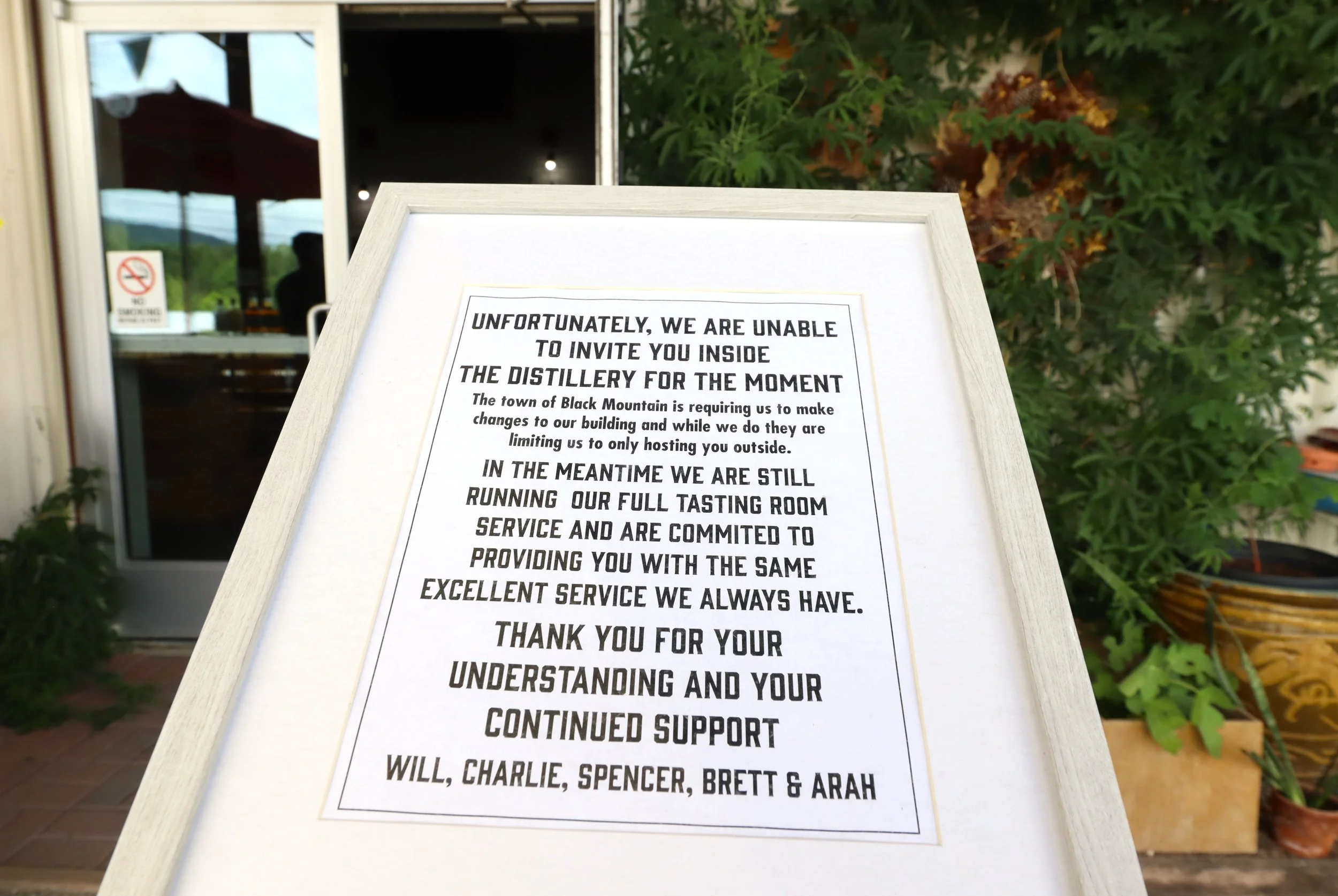
A sign posted outside of the entrance to Oak and Grist Distilling Co. advises customers to remain outdoors, as the Black Mountain business attempts to comply with a recent ruling by town officials. Photo by Fred McCormick
“We have been operating under the code that was in place when we were given our certificate of occupancy, back in 2017,” Goldberg said, adding he was unclear about the town’s specific concerns, as he prepared to meet with officials earlier this month. “I went in assuming there would be conversations about the concerns and things that needed to be addressed. I believed there would be an opportunity to ask clarifying questions on some of the things they were asking us to do.”
By the end of that meeting, which the town reports included ownership and a design team representing the business and the municipality’s fire chief, planning director, fire marshal and building inspector, Goldberg was informed the public would not be allowed inside the building until a temporary storage solution was completed. The plan of action, created by the town’s building and fire inspector, compelled the business owner to “choose his path to compliance” for bulk storage from the 2018 building code or chapter 40 of the 2024 N.C. Fire Protection Code, according to the planning director’s report.
“We have always operated under our understanding of the fire code,” Goldberg said. “Both, the fire and building inspectors have walked through this building, and neither of them ever raised a concern, verbally or written, about our operation.”
Under the temporary option offered by local officials, employees are allowed to work in the building, provided they are informed of the town’s recent assessment of the conditions. The municipality is allowing the business 90 days to reach full compliance.
The distillery is currently exploring the possibility of storing the whiskey outside of the building.
“As a distillery, not only do we have to comply with state and local laws, but also federal guidelines. It’s not as simple as throwing barrels out back,” Goldberg said. “Federal guidelines have to be balanced with the town's temporary solution for storage of barrels.”
Staff are scrambling to adapt to the town’s directives, the owner added.
“We have a team of architects and engineers that have been working, day and night, to come up with a plan and solution for renovations of our property to meet the building and fire code that Black Mountain is presenting to us,” Goldberg said. “We are actively working to come up with a solution.”
The situation, he continued, places the business in a precarious position.
“Any capital improvement project takes time and money. The question becomes, after nine years, given no reason to believe we were out of compliance, how are we now being told to make significant changes to our building in order to continue our production and storage operations?” Goldberg said. “That comes with a financial cost. We’ve had no indication in the past nine years that our current facility required capital investment to be up to code, because nobody told us we were out of compliance.”