
Film screenings take Swannanoa back to mill town roots
‘Blanket Town: The Rise & Fall of an American Mill Town’ to be featured in a pair of Beacon Village showings
Fred McCormick
The Valley Echo
February 18, 2026
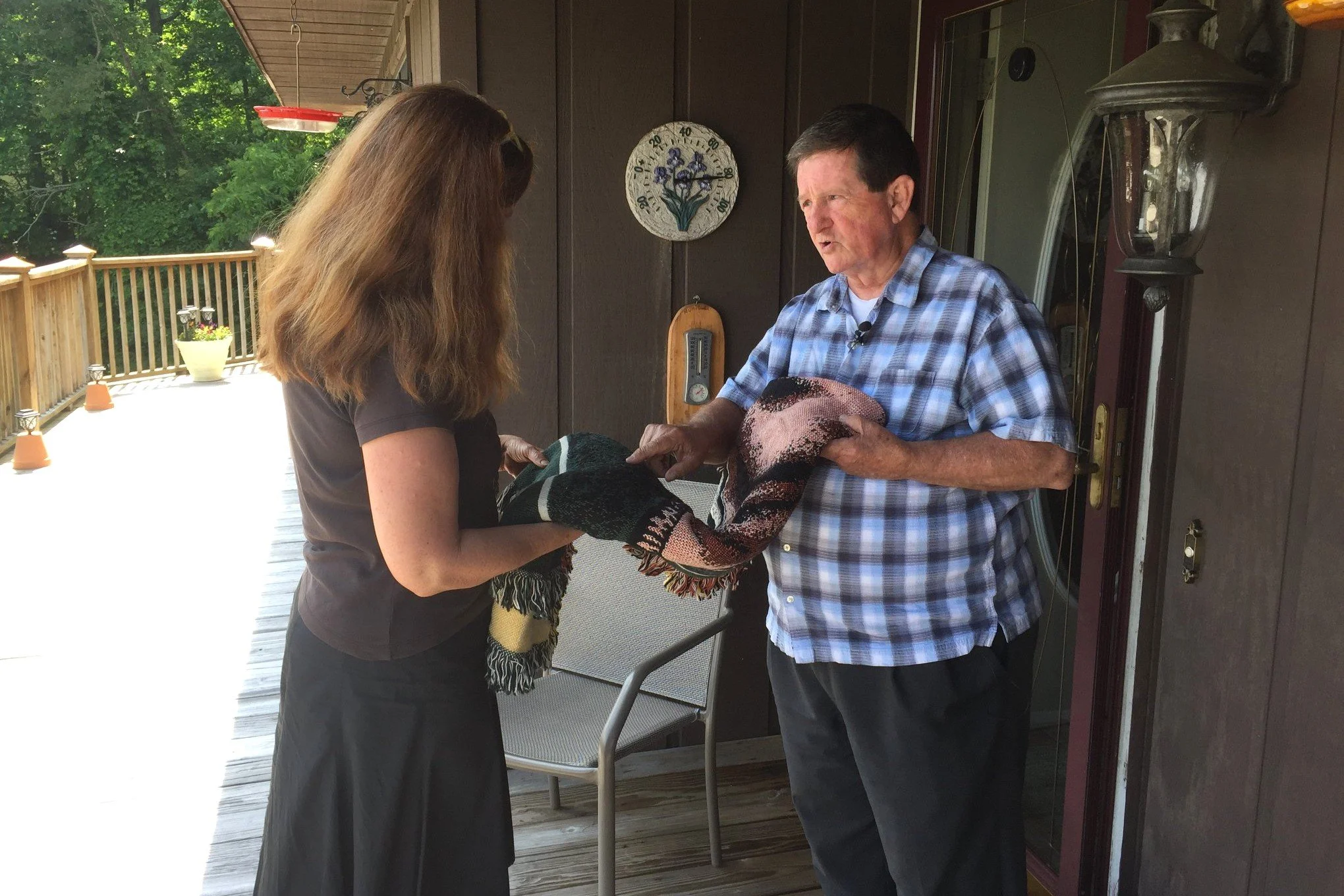
Rebecca Williams examines a Beacon blanket with a former employee of the Swannanoa mill while making “Blanket Town: The Rise & Fall of an American Mill Town.” The documentary, which was produced over 12 years, will be shown, Feb 21, in the former church building on Whitson Avenue. Courtesy photo
Nearly a century ago, a sparsely populated farming and railroad community in the Appalachian Mountains was changed forever, when Charles D. Owen II relocated his family’s textile mill from New Bedford, Massachusetts to Swannanoa. At one-million-square-feet, Beacon Manufacturing soon became the center of a thriving unincorporated village between the train tracks and Swannanoa River, where generations of factory employees and their families lived, played and worked, side-by-side.
Few people have dedicated as much time and effort to understanding how its identity as a mill town shaped the future and present of Swannanoa as filmmaker Rebecca Williams, who is will screen her award-winning documentary, “Blanket Town: The Rise and Fall of an American Mill Town,” at 3 p.m. and 7 p.m., Saturday, Feb. 21. The event, hosted by the Swannanoa Grassroots Alliance in the former Methodist Church at 216 Whitson Avenue, is free to the public, while donations for the project will be accepted.
The documentary was produced over 12 years by Williams and her husband Jerald Pope, who moved to Swannanoa in the early 2000s. Like many of their neighbors, the couple gathered around the former site of the mill, which had been shuttered for more than a year, after a fire that raged for days destroyed the structure in September of 2003. Amidst the devastation of one of the largest structure fires in N.C. history, they were compelled to understand the overwhelming sense of grief they encountered among the longtime residents gathered at the scene.
Prompted by the urging of Charles D. Owen III, whose name was given to the Swannanoa Valley’s public middle and high schools following consolidation in 1955, his father moved the facility, by rail, to the mountains in the early 1920s. Construction of the mill, a small adjacent business district and employee housing, which stands today as upper and lower Beacon Village, was completed during the Great Depression.
Around the middle of the century, Beacon employed nearly 2,300 workers from across the region and became the largest blanket manufacturer in the world. At the apex of its productivity, the mill operated 24 hours a day, while providing services, including recreation, for its workforce.
Beacon blankets, known for their distinct and colorful patterns, are now collectible items, but the business struggled during the decline of the U.S. textile industry in the second half of the century. The company closed its doors in 2002, but the massive structure stood as a physical reminder of the community’s recent past and a symbol of hope for the future. In early fall of the following year, an arsonist set the empty facility ablaze.
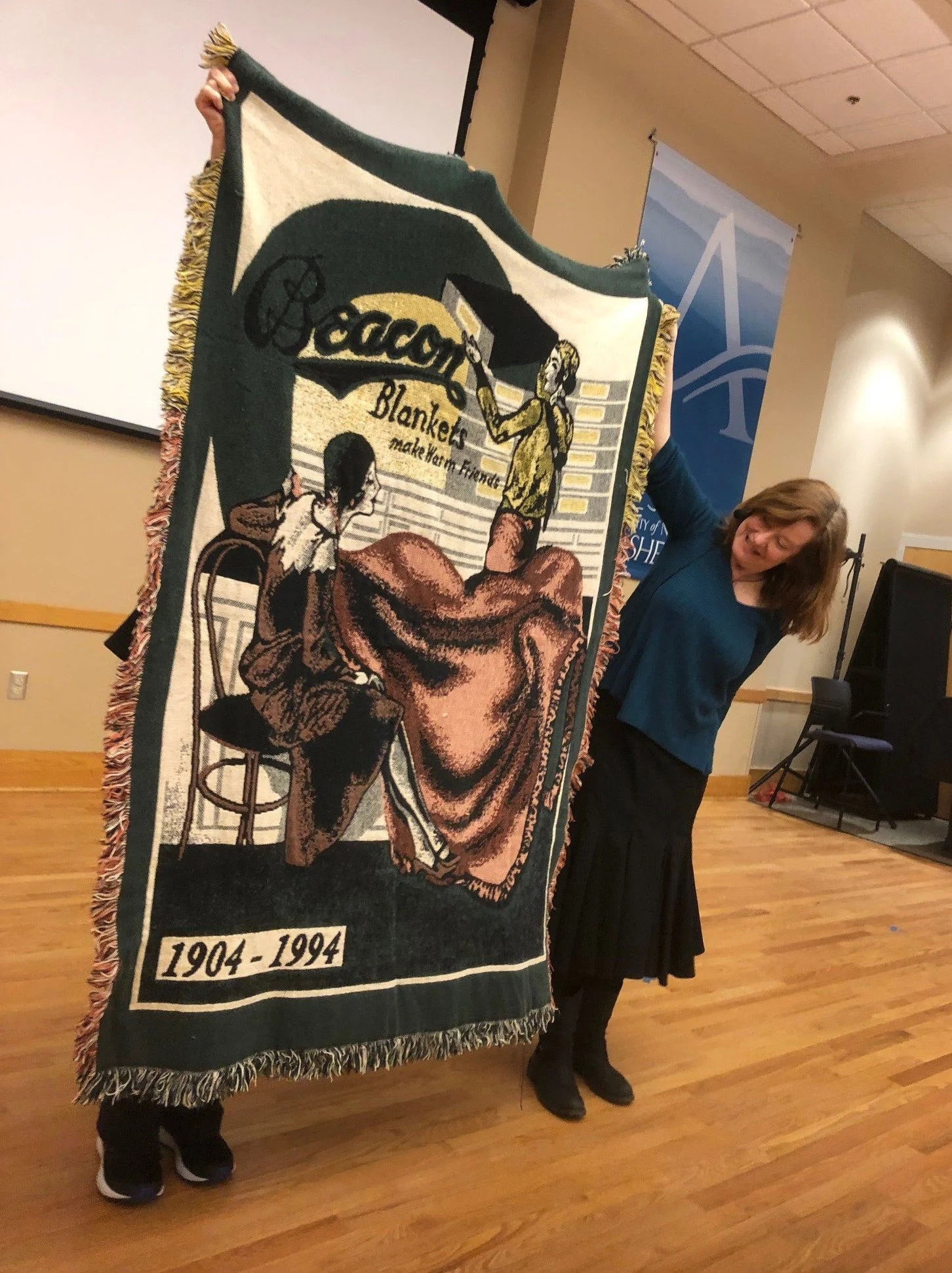
Rebecca Williams displays a commemorative Beacon blanket, while producing her documentary, “Blanket Town: The Rise & Fall of an American Mill Town.” Courtesy photo
The fire burned for three days, as nearly 400 firefighters from agencies throughout Buncombe County, worked to suppress it. Former employees and local residents, many with generational connections to the company, gathered around the perimeter throughout the event that dramatically altered the Swannanoa landscape.
During the making of “Blanket Town,” Williams, through her nonprofit Serpent Child Productions, interviewed nearly 100 former Beacon employees, beginning in 2008. Multiple subjects, some of whom worked at the mill for decades, were still living in or around Beacon Village when the documentarian began collecting their stories. Williams and Pope held a preview of the film near the site in 2022, shortly after it earned recognition as best overall documentary feature in the Longleaf Film Festival.
The abrupt loss of the mill marked the beginning of an uncertain future for Swannanoa, before another tragedy struck in September of 2024, when flooding from Helene claimed dozens of lives in Buncombe County and destroyed multiple homes and businesses along the river.
“After the hurricane, I felt we had to show this film again, but it was too tender of a time,” Williams said. “But, nearly a year-and-a-half later, I feel like it has a particularly special resonance now, as Swannanoa is once again rebuilding and reinventing itself.”
While Williams and Pope sense an “exciting energy” emerging in Swannanoa, they hope the documentary can offer newcomers to the area a deeper understanding of the community.
“We meet people all the time who moved here a year or two ago,” said Williams, who works at the Rite Buy Grocery, one of several new businesses to open in the downtown district near the former Beacon site. “Most of them have no idea why these commercial buildings are here or what used to be in that big field.”
With a bike park, walking trails and a community green space anticipated to open on the former site in the coming months and businesses returning to the former economic center of the unincorporated town, the moment marks an appropriate time to reflect on the community’s past, according to Williams.
“It's a good time to remember was here, as Swannanoa is building for the future,” she said. “I’ve heard it said before that history is like therapy for the present. To understand where you’re going, you need to know where you have been.”
Both “Blanket Town” screenings will be held at no cost, but attendees are encouraged to arrive early, as seating is limited.
“This is one way we can show gratitude for all of the community support we’ve received while making this documentary all these years,” Williams said. “We also want to thank the Swannanoa Grassroots Alliance for supporting this event.”