
Community land trust to grow ‘Roots’ in Black Mountain
Nonprofit organization launches project to keep Helene survivors in WNC
Fred McCormick
The Valley Echo
May 7, 2026
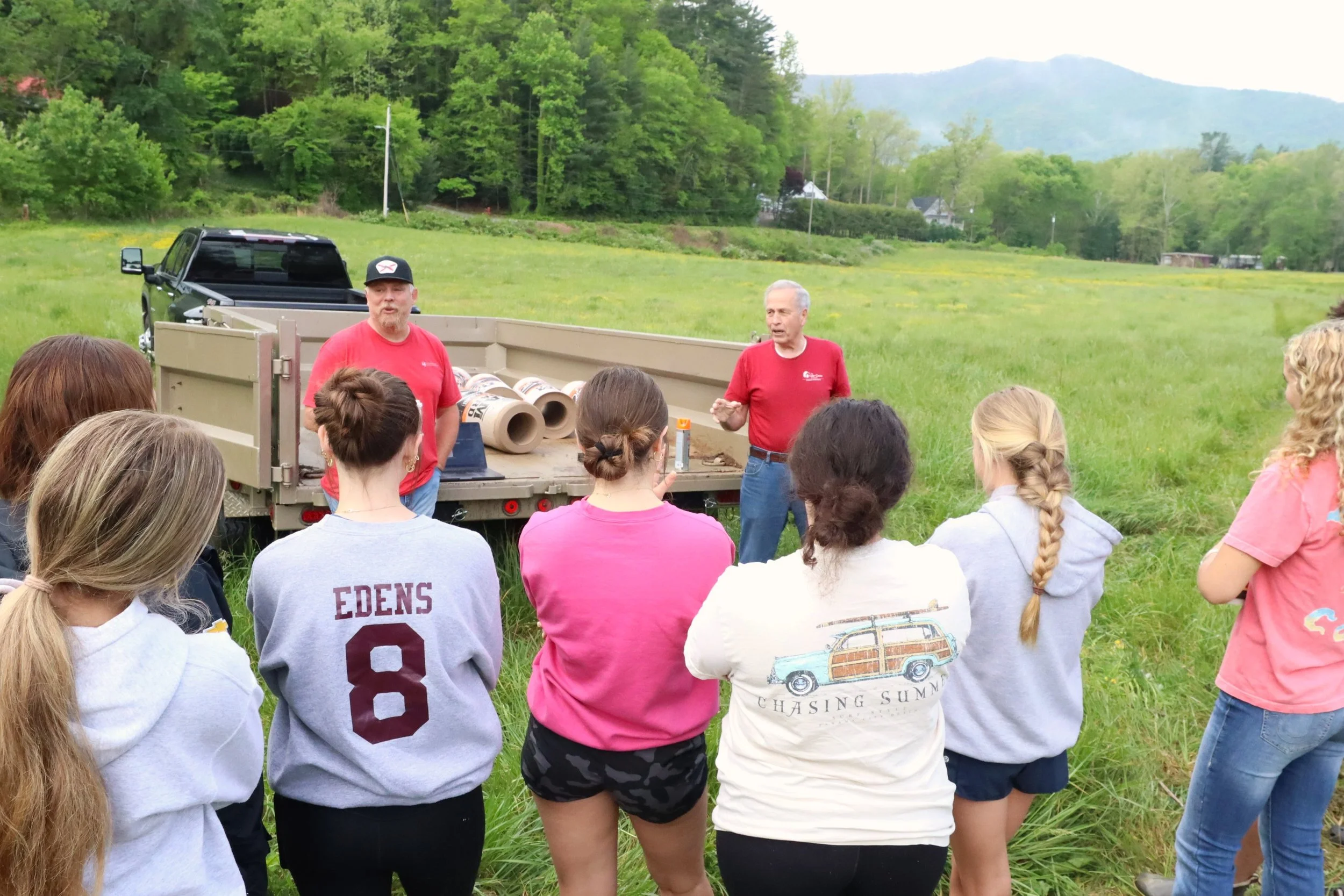
Nathan West, left, and Bart Tucker welcome students from the Interact Club at Owen High School, April 29, as Fuller Center Disaster ReBuilders launches Roots, a community land trust in Black Mountain. Photo by Fred McCormick
The gathering of approximately 15 local high school students, staff, members of the Rotary Club of Black Mountain Swannanoa and representatives from Fuller Center Disaster ReBuilders, April 29, on the edge of a pasture on Blue Ridge Road would have appeared unassuming to the casual observer, but it marked the humble beginning of a project designed to keep survivors of Helene in the Swannanoa Valley.
As the group began preparing the 10-acre site for the development of 50 homes, Roots, a planned community land trust, was embarking on its mission to provide affordable housing to Western N.C. residents displaced or impacted by the 2024 natural disaster.
Roots, an acronym representing “Resilience, Opportunity, Ownership, Trust and Stability,” is a collaborative initiative led by Fuller Center Disaster ReBuilders, which arrived in the Swannanoa Valley in the immediate aftermath of the devastating floods that damaged or destroyed thousands of homes in Buncombe and surrounding counties. The nonprofit organization, founded in response to Hurricane Katrina in 2005, quickly organized volunteers to assist homeowners with mucking damaged homes in Swannanoa and Black Mountain.
Realizing the storm’s widespread impact on uninsured and low- to moderate-income homeowners, the organization, which leverages a vast network of volunteers to offset labor costs, committed to establishing a long-term presence in the region. Local resident Nathan West was hired to serve as the director for operations in WNC, overseeing the restoration of more than 30 homes in Buncombe and Yancey Counties.
West, last summer, announced the nonprofit’s plans to develop the lot at 399 Blue Ridge Road for the construction of a community consisting of single-family homes, duplexes, green space and dog parks. The CLT incorporates a model that leases the land, while allowing buyers to purchase homes at a cost below the market price. The nonprofit structure will be directed by a board consisting of residents and community representatives, according to its founders.
The CLT model, designed to preserve affordable housing options, particularly in areas experiencing significant increases in real estate costs, is currently utilized by more than 350 communities in 46 states. Fuller Center Disaster ReBuilders, in July of 2025, was awarded an $850,000 grant for the project from the Community Foundation of WNC.
Roots hosted its first information session for potential buyers, April 27, at Black Mountain Presbyterian Church, while development of the first 35 homes will commence in the coming weeks, according to West, upon the approval of final permits.
Eligible prospective homebuyers are required to earn below 80% of the area median income and complete an approved eight-hour homebuyer counseling course.
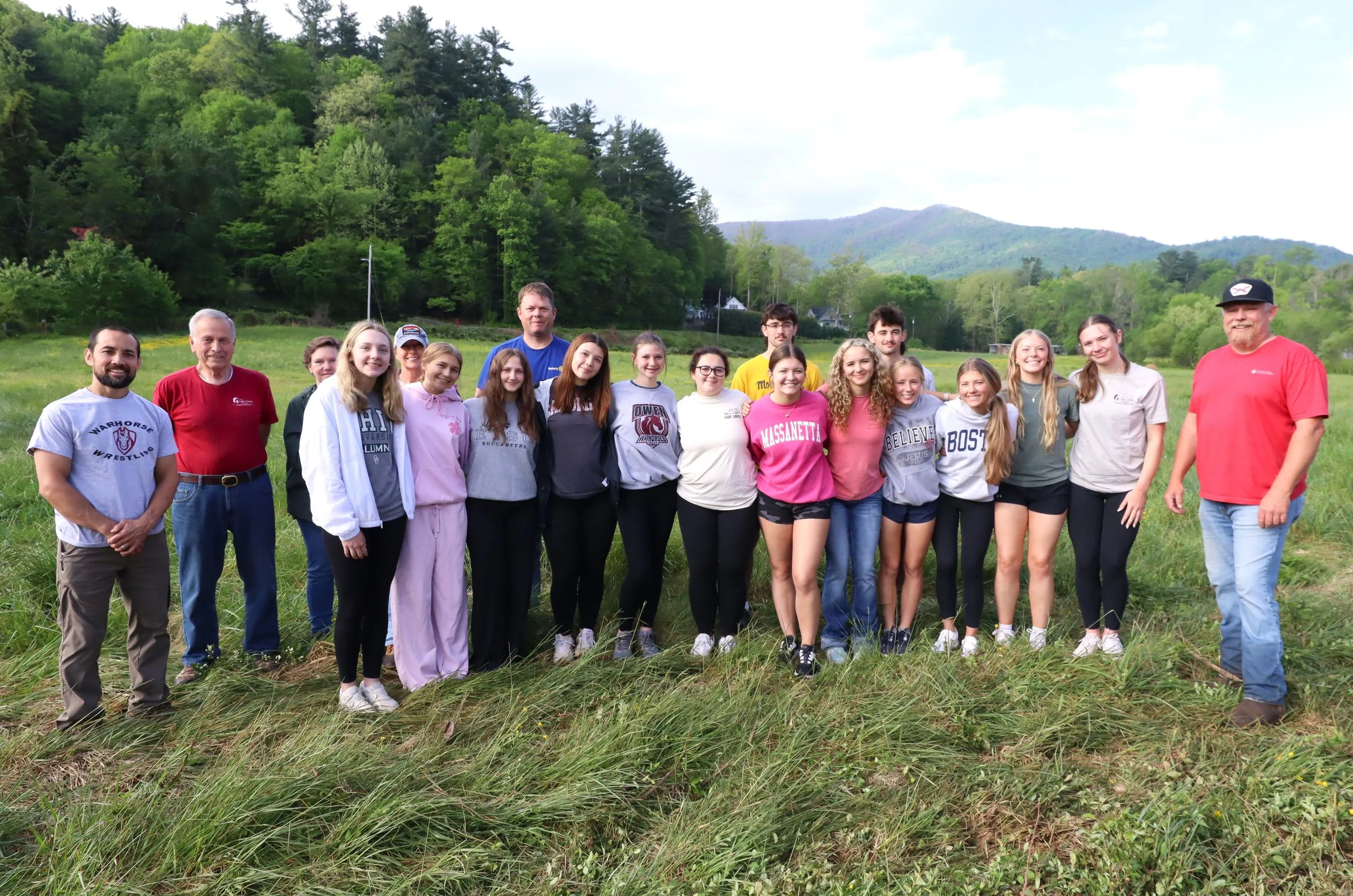
Volunteers from Owen gather, April 29, to support the Roots Community Land Trust in Black Mountain. Photo by Fred McCormick
“Our first priority is people who lost their homes in Helene and can’t build back on their land. Priority two is people who may have owned a mobile home or lived with someone in a house that was lost, and are now unable to put one back in that area,” West said. “We also want to work with people impacted by Helene, whose living circumstances changed. Our fourth priority is first-time homeowners, including generational renters and others who are part of the workforce and can’t afford something on the open market.”
Homes in the CLT, priced at a maximum of $185,000 and assuming no money down with a 6.5% interest rate in a 30-year fixed mortgage, would carry an estimated total monthly cost of approximately $1,500.
“When they sell it back to the community land trust, usually to purchase a new home, 25% of the equity they gained goes back to them,” West said. “After seven years, around 70% of people who live in a community land trust go into the open market when they sell.”
A key aspect of controlling the potential cost of housing in the community relies on the support of Fuller Center’s network of volunteer labor.
“We’re working with partners from all over the country, including Mennonite Disaster Services, Anglican Relief and Development Fund and others,” West said. “Those organizations have connections with other organization, and that has helped increase the visibility and funding opportunities for this project.”
Students representing the Interact Club from Owen High School volunteered to begin landscaping a welcome area in the northeast corner of the site. The group was greeted by Fuller Center for Housing Disaster ReBuilders President Bart Tucker and West.
“Our club is a Rotary-inspired service club, and we wanted to come out here today and we wanted to volunteer doing something that helps rebuild our community,” said Adeline West, the daughter of Nathan.
The club selected the volunteer opportunity, which included removing debris from the edge of the pasture and clearing a space for landscaping, to support the planned development, according to vice president Scarlet Gilham.
“This is our first project, and we’re excited to come out and participate in this,” she said. “We meet every other week, and this was one of the first opportunities we had. It was really interesting to learn about this community and how it will help people who were victims of Helene.”
West anticipates the first residents of Roots will move in around the beginning of next year.
“All of our work with the Fuller Center has been focused on helping people who didn’t have a lot of options after Helene,” West said. “A lot of these folks are people who work right here in this community, and we believe this community land trust will serve as a stepping stone to keep them here.”