
Black Mountain Town Council hears proposal to balance upcoming budget
Interim town manager presents elected leaders with series of potential cuts, increased property tax, sanitation and water rates
Fred McCormick
The Valley Echo
June 5, 2026
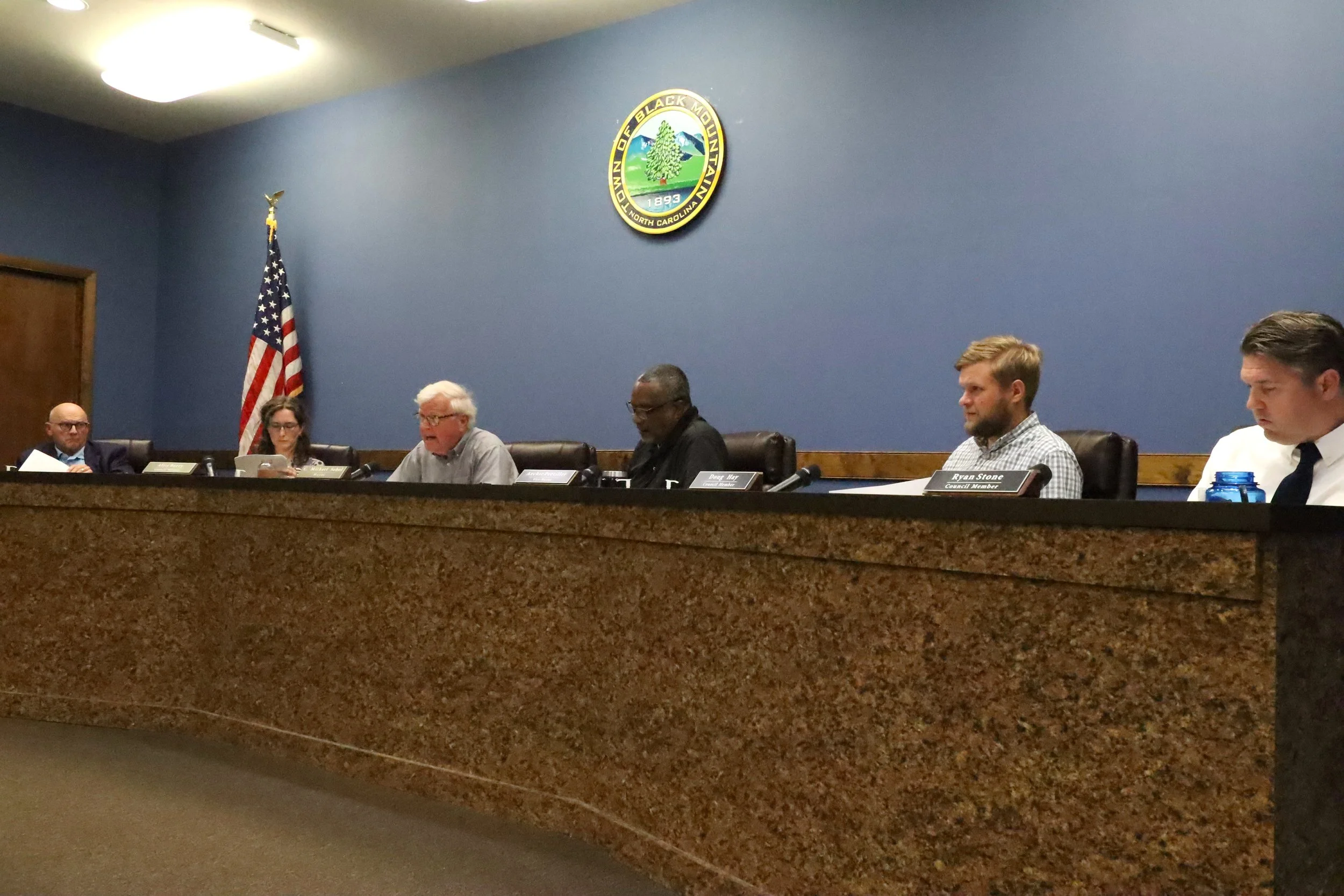
The Black Mountain Town Council, in a June 4 workshop, discusses recommendations to overcome an approximately $2.8 million shortfall in its general and water funds. Photo by Fred McCormick
A proposal that would result in freezing or eliminating nine positions within the Town of Black Mountain, while increasing property tax, solid waste and water rates for residents was presented, June 4, as elected officials met for the latest in a series of budget workshops.
The session, which followed an agenda review meeting, included specific recommendations from the interim town manager, intended to overcome an approximately $2.8 million combined shortfall in the municipality’s 2026-27 general and water funds.
Balancing the town’s general fund budget, in which expenditures were anticipated to outpace revenue by $1,858,260, would require a nearly $915,000 reduction in spending, while increasing income by a total of $937,000, according to numbers presented by the temporary administrator, Richard Hicks.
Proposed reductions in expenditures include freezing the town’s vacant assistant manager position for one year, eliminating $181,450 in salary and benefits, while an additional $121,312 would be preserved by a concurrent freeze of the project manager role. Eliminating the vacant public information officer position, which was added at the beginning of the current fiscal year, would reduce annual expenditures by an additional $112,932, Hicks told the town council.
The manager also identified two unspecified positions, both currently occupied, for possible elimination, reducing the overall costs of salaries and benefits by approximately $184,000.
A one-year freeze on a vacant position within the Black Mountain Police Department would reduce general fund expenditures by another $83,000, according to Hicks.
“Or, as an option, you could budget a 5% vacancy rate,” he said of the BMPD fund. “Basically, what that is, instead of budgeting 100% for salaries, you realize in the next fiscal year you will have vacancies, so you won’t spend all of your salary money. That makes up that same difference.”
Further cost-cutting measures proposed by Hicks include transferring approximately $282,000 from the town’s hurricane relief fund to pay off debt associated with police vehicles and the town square, while eliminating $24,000 of the municipality’s contributions to the Fonta Flora Trail, Swannanoa Valley Museum and Swannanoa Valley Christian Ministry.
“It’s not in our best interest, or the board’s to spend hours and hours picking up $500 here or $700 there to try to balance the budget,” Hicks said. “To balance it, we would fund $100,000 out of the (unassigned) fund balance, and as soon as the budget is adopted, within 90 to 120 days, we will identify an additional $100,000 worth of cuts… We think we can find those, but it takes a little time to look at the numbers.”
Increasing the town’s projected revenue will require a property tax increase of 2 cents per $100 of valuation, based on reassessed values. The property tax increase would likely be closer to 3.5 to 4 cents if the General Assembly passes Senate Bill 889, which would freeze property values for the upcoming fiscal year.
“That generates about $526,000,” said Hicks, whose proposal also calls for a monthly increase of $3.50, per customer, in sanitation fees. Increasing green fees for the Black Mountain Golf Course by $7 per round, according to the administrator, would generate $154,000 in revenue, based on 22,000 rounds of 18 holes in the fiscal year.
The combined reductions and revenue projections, he added, will even the nearly $1.9 million shortfall in the general fund budget.
Options to adjust the fire department budget include freezing one firefighting position that is currently occupied, or reducing part-time salaries by $80,240 per year. Hicks suggested removing a request for an $18,000 drone.
“Where this gets more interesting, is that just about every department in Buncombe County will be paying firefighters around $60,000 per year, and you’re currently at $48,000,” he said. “If you don’t do something, I think you will run a huge risk of losing a significant number of your firefighters, because there are a lot of vacancies in Buncombe County.”
Hicks proposed an annual raise of $10,000 for 15 firefighters and engineers, a $5,000 increase for the department’s six lieutenants and a 3% salary bump for three battalion chiefs, the fire inspector, assistant chief and chief.
The total costs of salary increases and benefits for the fire department would cost $264,720, with the Buncombe County district contributing $108,535, while the town would subsidized the pay structure with $135,007.
“You’re basically spending $69,000 to maximize whatever Buncombe County is giving you, and you will still fall short of the county’s actual allocation that you’re eligible for,” he said.
Balancing a $919,655 deficit in the town’s water fund will require a reduction of $237,347 in expenditures, combined with a projected revenue adjustment of $682,308, according to the manager. Proposed cost reduction measures, amid a 33% increase for wholesale customers of the City of Asheville, which supplies the town with up to 70% of its water, include eliminating one position that is currently occupied, and a one-year freeze on the department’s funding for half of a position shared with the public works department.
Increased water revenues would be generated by increasing the base rate of $6.14 per month by an additional $7, while increasing the usage rate by 18 cents per 100 gallons. The new rates, Hicks added, would result in increases of approximately $16 per month for customers purchasing water from the Town of Black Mountain.
With the combined proposed changes to the general and water funds, residents with a home valued at $500,000 would likely see an annual increase of $334, or $27.83 per month, in property taxes, water and sanitation fees, according to Hicks.
“This is a painful budget year,” said Councilmember Alice Berry. “So, thank you for bringing us some options.”
The town’s budget issues are exacerbated by a “poorly constructed” current spending plan, according to Councilmember Larry Harris.
“It’s just catch-up time,” he said. “In particular, when you look at the water fund, you don’t have a choice, you simply have to pay for the water that is produced.”
Budget discussions in recent weeks, Councilmember Doug Hay, present multiple options to address the current shortfall.
“We can solve one problem by removing something from this budget, but if it creates a problem next year or the following year, because we didn’t get a truck or didn’t invest in our staff, and they leave us, that just creates another problem we will have to deal with,” he said. “I can’t stress enough how important it is, for me at least, to see a very modest (cost of living adjustment) increase for our staff and firefighters, helping close that gap.”
Rising costs are impacting municipalities throughout the region, according to Councilmember Ryan Stone.
“We’re not immune from everything that’s going on around us, and every municipality and county around us is doing some version of what we are, but ours is extreme,” he said. “But, they’re all looking at increasing revenue, either through taxes or fees, and cutting services. It’s unpleasant, and none of us want this for our employees or neighbors, but this is the hand we were dealt.”
Officials will continue to evaluate conditions in the future, Stone added.
“This is for one year, and we’ll get through it and make adjustments, as necessary,” he said. “Just like we did after the storm, if we can come together, this is a community that does more with less, better than anybody. We’ll get through this and be in a better position, long-term, than we were in before.”
The town council will hold its final budget workshop at 8:30 a.m., Thursday, June 11, prior to the public hearing on the document, which will take place at 6 p.m., Monday, June 15.