
Black Mountain College Studies Building listed among 'Irreplaceable America' sites
World Monuments Fund names landmark one of 10 entries as local nonprofit launches restoration campaign
Fred McCormick
The Valley Echo
July 1, 2026
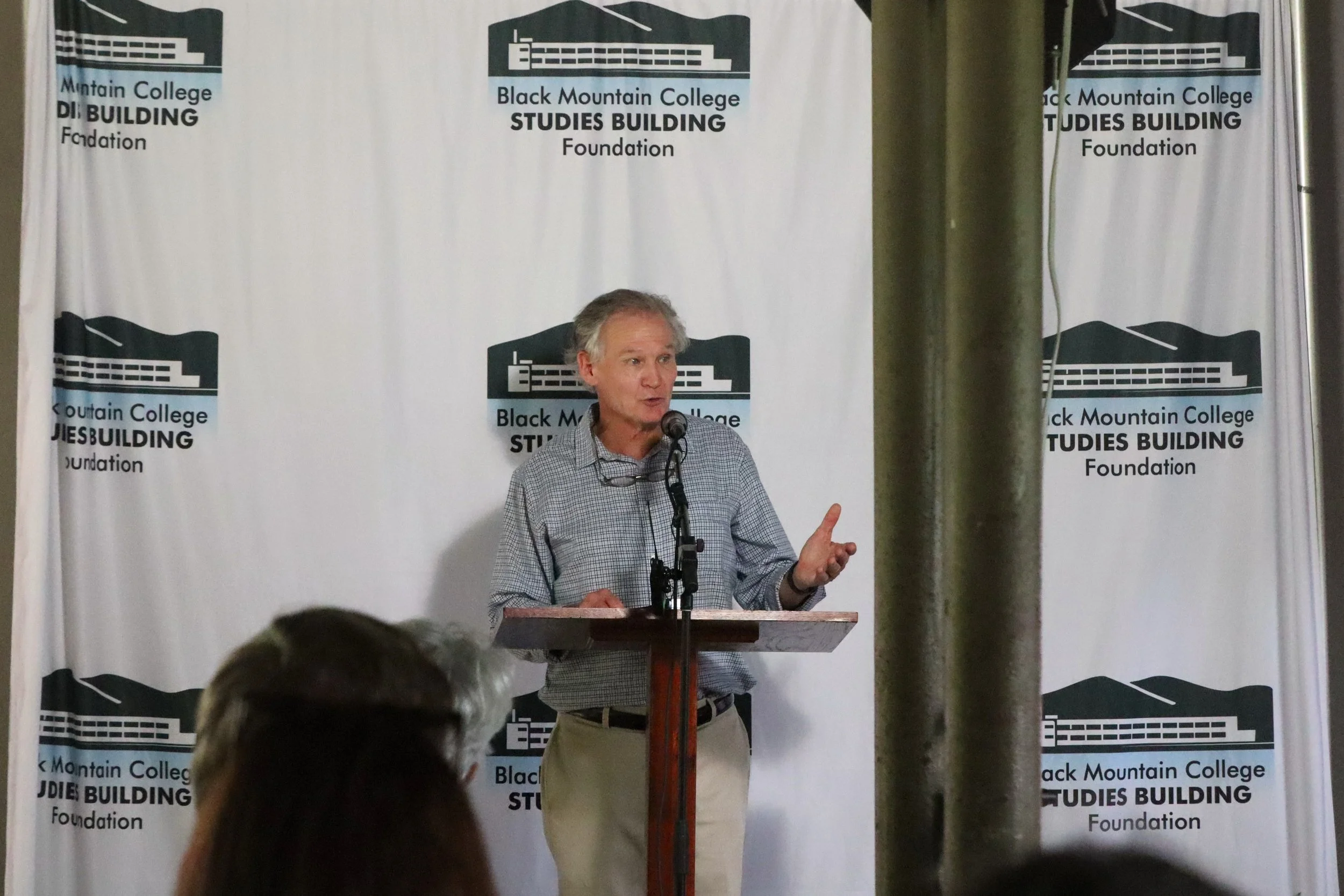
Chuck Flournoy, the executive director of the Black Mountain College Studies Building Foundation, hosts an event, June 30, announcing the structure’s inclusion on the Irreplaceable America list, by the World Monuments Fund. Photo by Fred McCormick
For nearly a quarter century, many of the most influential artists of their era gathered within picturesque settings in the Swannanoa Valley, where they pioneered a groundbreaking approach to liberal arts education. From its founding in 1933 until its closure in 1957, Black Mountain College hosted figures like Buckminster Fuller, Josef Albers, Anni Albers, John Cage, Jacob Lawrence and other prominent artists among its faculty members and students.
The spirit of the unconventional institution is represented in the 84-year-old structure that once served as the center of academic life on the campus, now home to Camp Rockmont, where dozens gathered, June 30, as the Black Mountain College Studies Building was one of 10 historical sites to be named, by the World Monuments Fund to the Irreplaceable America list.
The event, which marked the launch of a restoration campaign by the nonprofit organization Black Mountain College Studies Building Foundation, celebrated the structure’s unique significance in American history, as the country prepares to commemorate its 250th anniversary. Guest speakers, introduced by the foundation’s executive director, Chuck Flournoy, included N.C. Deputy Secretary for Office of Archives and History Dr. Darin Waters, president of Explore Asheville, Vic Isley and writer Amanda Fortini, whose 2022 piece—”Why Are We Still Talking About Black Mountain College?”—rekindled interest in the site when it appeared in The New York Times.
“It’s very fitting, because Black Mountain College and its Studies Building are quintessentially American,” Flournoy said. “The themes you will hear today as people speak are stories of courage, creativity, collaboration, innovation, ingenuity and resilience. All of these define and undergird the American experience, and they are all epitomized and codified in this college and this building.”
Designed by architect and educator A. Lawrence Kocher, in collaboration with Walter Gropius and Marcel Breuer, the structure incorporates Bauhaus principles, on the edge of Lake Eden, in the rural setting of Western N.C. The building, completed in 1942, was originally constructed by unskilled student labor, using wood and stone sourced from the surrounding mountains. While the overall design proposed four spokes around a central radius, the full project was never completed, due to lack of funding.
Fortini, a fellow at the Black Mountain Institute at the University of Nevada, Las Vegas, characterized the opportunity to officially announce the addition of the Studies Building to the Irreplaceable America list as a “true honor.”
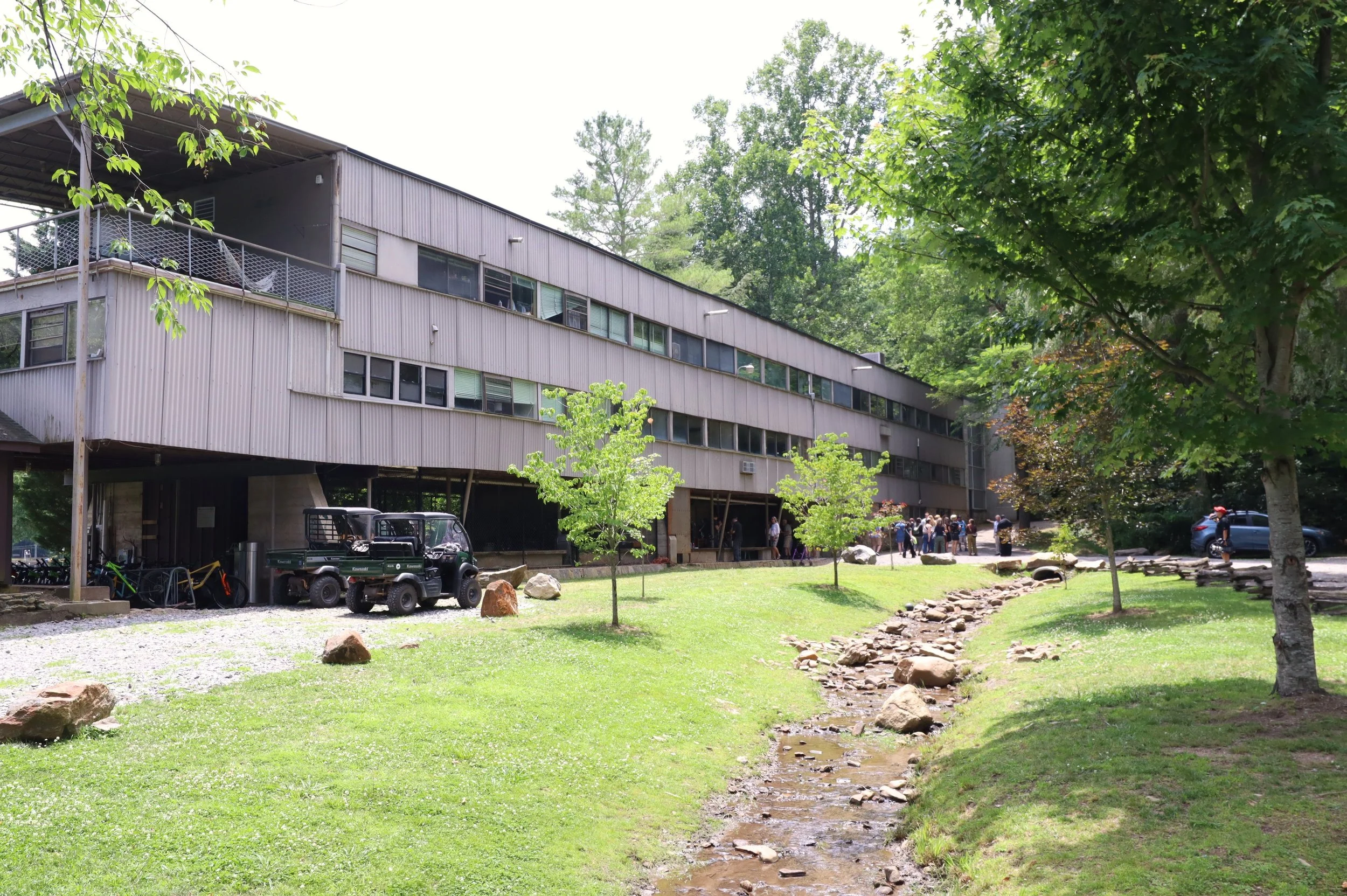
The Black Mountain College Studies Building, completed in 1942 by faculty and students of the liberal arts college from which it takes its name, is one of 10 structures added to the Irreplaceable America list by the World Monuments Fund. Photo by Fred McCormick
“Although I have never been here, physically, until now, I’ve spent a lot of time here in my mind,” said Fortini, whose work has been published by The New Yorker, Rolling Stone, The Paris Review and other international publications. “Four years ago, in the spring of 2022, I spent several months utterly immersed in the literature and lore of Black Mountain College, as I wrote a piece for The New York Times about its history, characters and enduring legacy.”
That article highlighted the college’s iconoclastic methods of education, abandoning traditional grades, degrees and class requirements, while becoming a haven for avant-garde artists fleeing Europe in the years leading up to World War II. Founded in its original location in the YMCA Blue Ridge Assembly by John Andrew Rice, following his dismissal from Rollins College in Winter Park, Florida, Black Mountain College was conceived as a community without hierarchy. The curriculum prioritized art as the central component of learning. The institution relocated, in 1941, to a 667-acre campus around Lake Eden.
“Nine decades since Black Mountain College’s founding, and we are still talking about it,” Fortini said. “There have been at least 10 books about Black Mountain College, probably more, multiple museum shows and I happen to know that two documentaries are in the process of being made right now.”
The cohort could be described as a “genius cluster,” she added, lending to the continued relevance of the defunct college.
“It’s wild that this remote school in this little town, at the foot of the Blue Ridge Mountains in rural N.C., would become the epicenter of avant-garde art, architecture and arts education in the 20th century,” Fortini said. “Here, for 25 years, a ragtag group of teachers, helmed most famously by the abstract artist and theorist Josef Albers, and in the 1950s by the poet Charles Olson, offered students a liberal arts education with art at its core.”
While the campus developed a reputation as an incubator for major artists, the unique relationship between teaching and learning remains a significant part of the college’s story, according to Fortini.
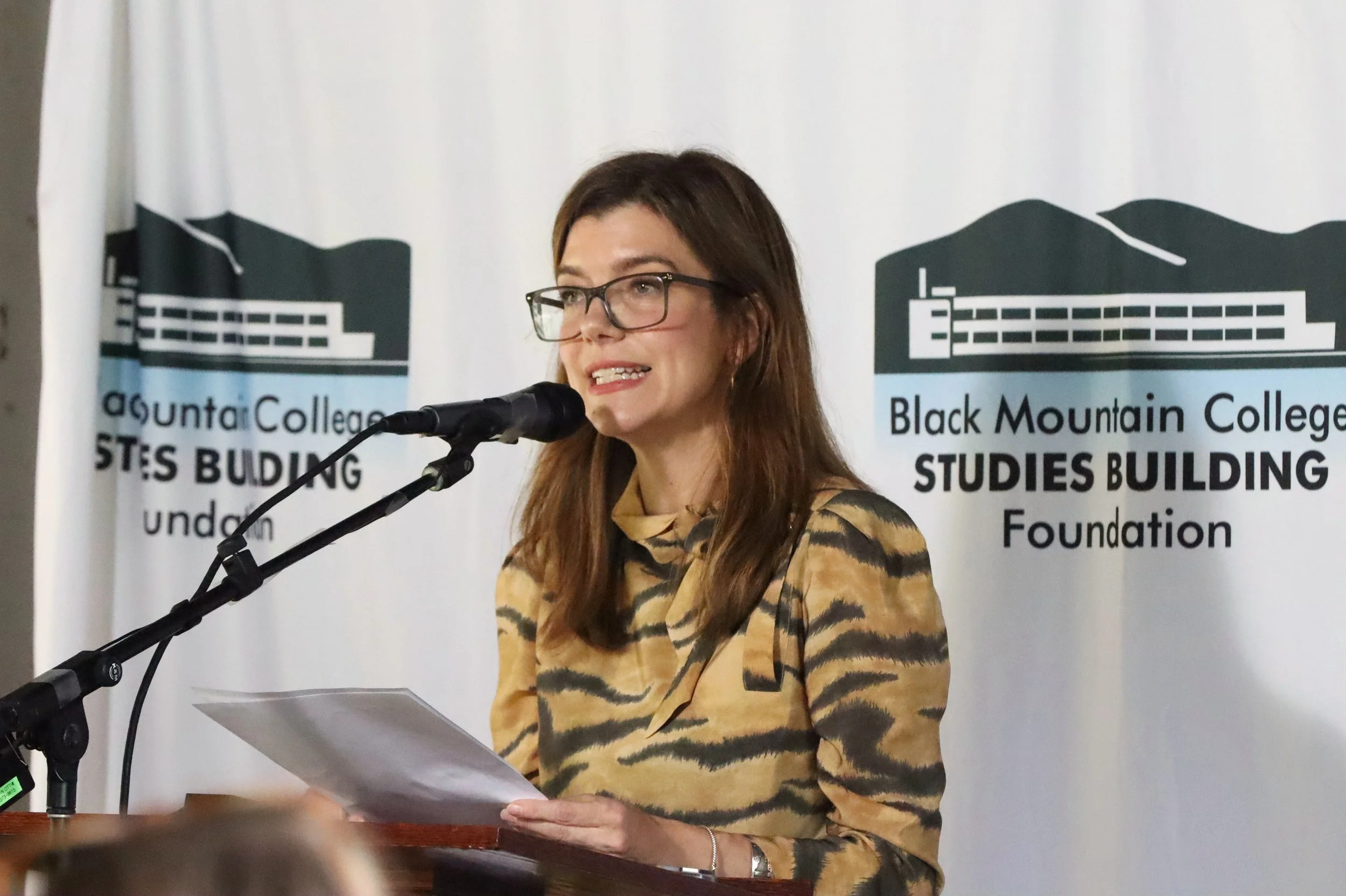
Writer Amanda Fortini, whose 2022 piece, “Why Are We Still Talking About Black Mountain College?” was published in The New York Times, announces, June 30, the remaining Studies Building has been added to the Irreplaceable America list. Photo by Fred McCormick
“It was rooted in the idea of learning by doing. It collapsed all hierarchies; it was run by faculty and students, alike, who lived together in the same building, participated in chores together and took their meals together,” she said. “There was no president, no dean, no board of trustees and there wasn’t even a curriculum or formal grades. Professors taught what they wished and students graduated when, or if, they wanted to.”
One of the defining innovations of Black Mountain College, she added, was its mission to produce thinking citizens, who were honed by the discipline inherent to the arts.
Mounting financial difficulties, the loss of key leaders, declining enrollment and a federal investigation into the institution’s methods in the 1950s, forced the closure of the college, which inspired other liberal arts institutions around the country. The property, previously developed by E.W. Grove, was purchased by the Pickering family, which established Camp Rockmont in 1956. Alumni from the camp, known collectively as Lake Eden Preserve, purchased it in 2021.
The Black Mountain College Studies Building Foundation was formed to secure funding needed to preserve and restore the structure to modern standards, with plans to operate the site as a center for creative arts. The cost of the project is expected to be approximately $18 million, according to the chair of the nonprofit organization’s board, Matthew Crawford.
Being recognized by the WMF as an Irreplaceable America site will increase awareness of the historical significance of the property.
“It’s truly amazing that this happened with the WMF, and we are honored to work with them, as we begin the process of restoring this building,” Crawford said. “As you’ve heard today, Black Mountain College and the Studies Building are known and appreciated throughout the world. For architects, the Studies Building is a fundamental component of their training. It’s one of the first extensions of the Bauhaus movement in the U.S.”
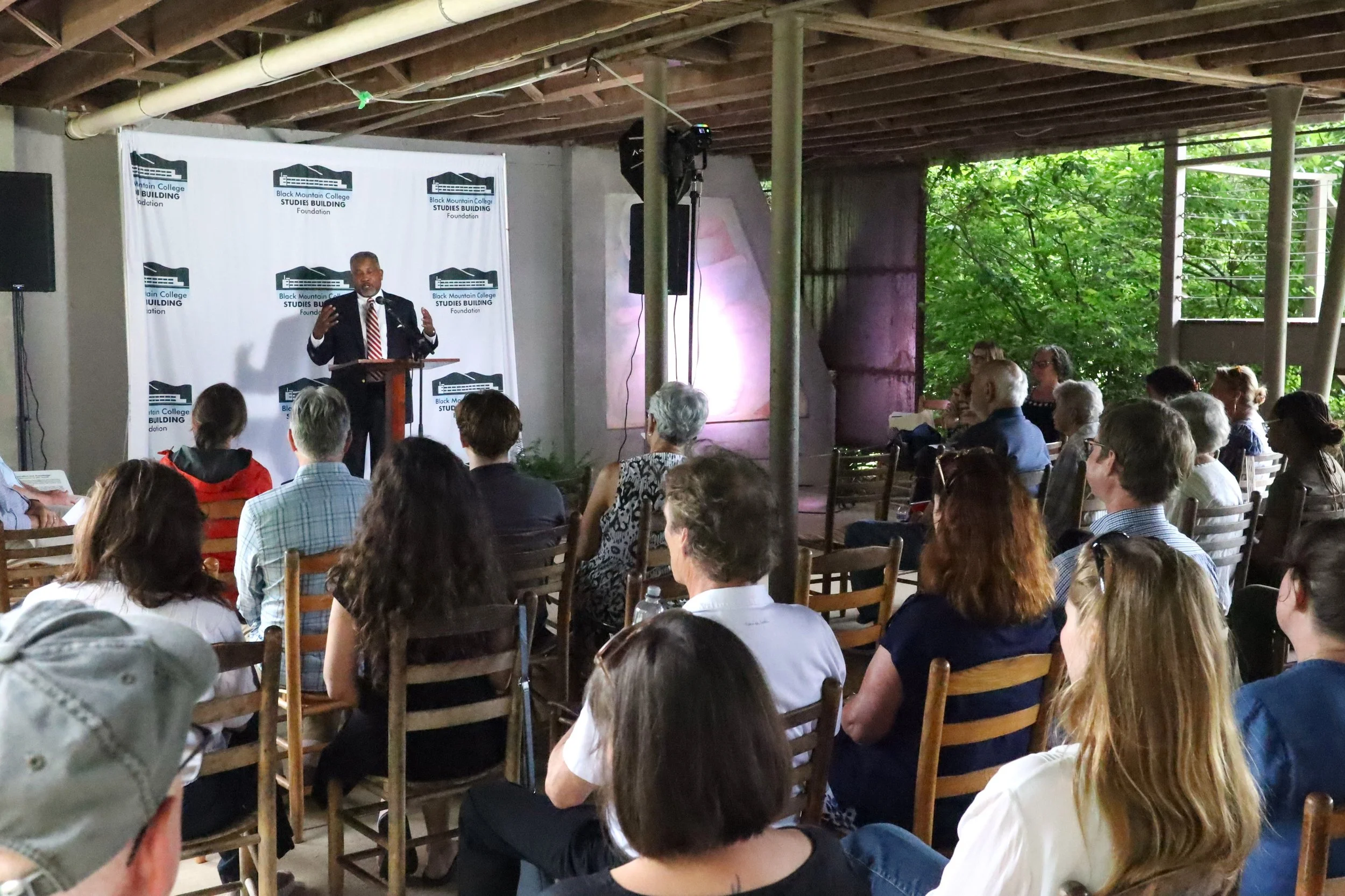
N.C. Deputy Secretary for Office of Archives and History Dr. Darin Waters speaks at Camp Rockmont, June 30, as the the Black Mountain College Studies Building Foundation announces the historical site’s addition to the Irreplaceable America list. Photo by Fred McCormick
For educators, he added, the landmark marks the physical location of a “shift in pedagogical paradigms.”
“That influence continues to be felt today, across our nation and around the world,” Crawford said. “We feel so strongly this building should be preserved in a historically accurate manner, so that its restoration can be used to create Black Mountain College for the next generation of artists. Musicians, creatives, teachers, visitors, as well as the young campers who come here during the summer. Chuck and I are calling it Black Mountain College 2.0.”
The foundation is working to secure the funds to achieve that vision, according to board chair, following the May announcement of a grant through the Andrew W. Mellon Foundation.
“Now our attention is focused on reaching out to other major foundations, corporations and individuals who support the arts, architecture and historic preservation…” Crawford said. “Assuming these efforts go as planned, the restoration work will begin in the fall of 2027, and hopefully, barring any surprises, be finished in the spring of 2029.”